

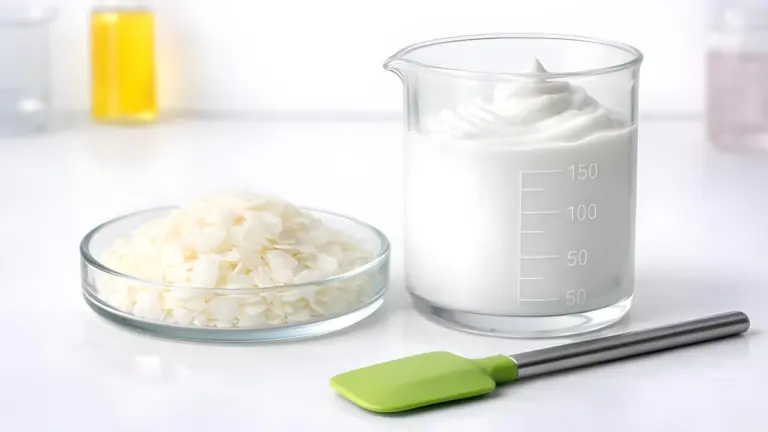
There are several different emulsifying waxes on the market, all with different names and chemical structures. People often call all of them emulsifying wax, but that glosses over real differences in how they behave once you start formulating.
BTMS-25 is one of those emulsifiers. It isn’t interchangeable with other products sold under similar names. Swapping it for something else will change how the finished formulation behaves.
*As an Amazon Associate, I earn from qualifying purchases
Table of Contents
INCI Name and Basic Composition
The INCI name for Emulsifying Wax BTMS-25 is Behentrimonium Methosulfate (and) Cetearyl Alcohol. INCI stands for International Nomenclature of Cosmetic Ingredients, which is the global standard for naming cosmetic ingredients, regardless of brand or supplier. Using INCI names clearly identifies ingredients, which is important since different products may share the same common name.
Behentrimonium Methosulfate
This is the functional part of BTMS-25. Despite the word Methosulfate in the name, it is not a sulfate in the sense people usually worry about. It does not behave like the harsh cleansing sulfates used in shampoos.
It is a quaternary ammonium compound made from behenic acid, a long-chain fatty acid most commonly derived from rapeseed oil. This chemical structure is what gives BTMS-25 its conditioning properties and explains its strong affinity for skin and hair.
Cetearyl Alcohol
This is included for structure and stability. It helps thicken the emulsion, improves texture, and supports a smooth, cohesive cream or lotion.
Despite the name, Cetearyl Alcohol is not a fermented or intoxicating alcohol. It is a fatty alcohol derived from plant oils and is chemically very different from ethanol. Because of this, it is generally considered suitable for halal formulations.
In practical terms, fatty alcohols like Cetearyl Alcohol act as emollients and structural ingredients. They are not drying, and they do not behave like the solvent alcohols used in toners or hand sanitisers.
The balance between these two components is what defines BTMS-25. It has less Behentrimonium Methosulfate than BTMS-50, so it’s a lighter conditioner and works a bit differently in formulations. This difference in composition is the main reason BTMS-25 and BTMS-50 should not be treated as interchangeable.
How BTMS-25 Works in Creams and Lotions
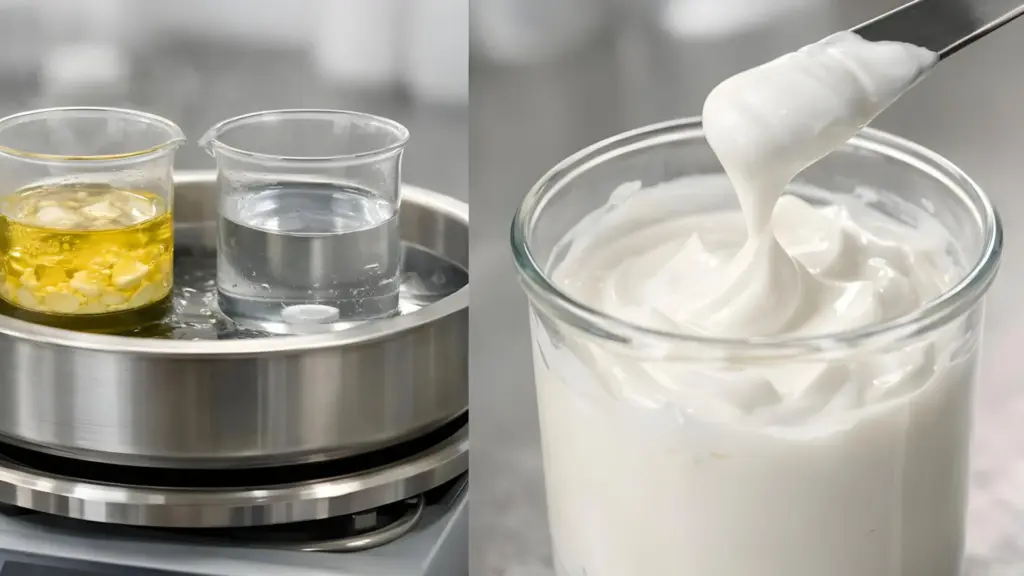
BTMS-25 works by forming a stable oil-in-water emulsion while also contributing a mild conditioning effect. It is not just holding oil and water together.
Cationic Behaviour in Emulsions
BTMS-25 is a cationic emulsifier, meaning it carries a positive charge. Skin and hair have a slight negative charge, so BTMS-25 is naturally attracted to them.
In practical terms, this means the emulsifier does not simply sit in the background of the formula. It binds with the surface of the skin or hair, which helps explain why creams made with BTMS-25 often feel more comfortable and settled once applied.
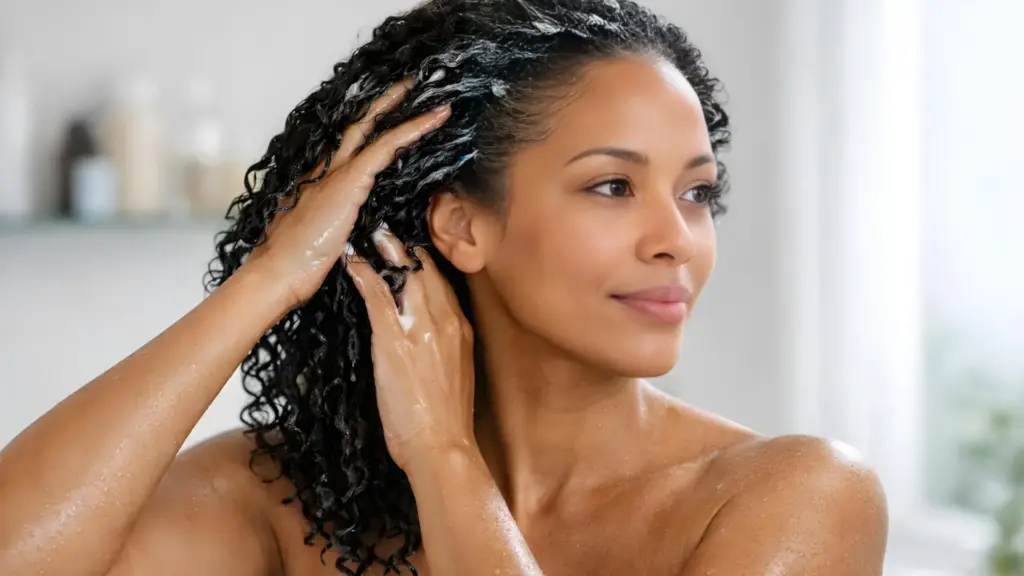
This same cationic behaviour is also why BTMS-25 works so well in hair conditioners. Hair carries a slight negative charge, especially when it’s damaged or colour-treated, so BTMS-25 binds easily to the hair shaft. This helps smooth the cuticle, reduce friction, and improve slip without needing heavy silicones.
In creams and lotions, that same charge interaction shows up as better slip, comfort, and a more settled after-feel on the skin.
Emulsification and Stability
In creams and lotions, BTMS-25 forms a reliable oil-in-water (O/W) emulsion without much fuss. It melts cleanly into the oil phase and emulsifies consistently once the water phase is added.
It handles a wide range of carrier oils, including heavier and more viscous ones. This makes it well suited to formulations containing cannabis-infused oils, which can be harder to emulsify cleanly with lighter emulsifiers.
Contribution to Structure
BTMS-25 helps give a cream or lotion its shape and body because of how it is built. The cetearyl alcohol that is already part of the emulsifier contributes thickness and structure without needing to add extra thickeners.
That built-in structure makes products more stable over time. Creams are less likely to thin out, split, or misbehave, especially if they are used regularly or kept somewhere warm.
What This Means in Practice
Creams that have BTMS-25 in them don’t just vanish when you put them on. The product feels light and comfortable on the skin, settling as you apply it instead of sitting on top. For dry, over-washed, or sensitive skin, a subtle conditioning effect can make a cream feel more beneficial without needing extra ingredients.
Skin Feel and Finish in Topical Formulations
Creams made with BTMS-25 tend to feel settled and comfortable on the skin rather than light or fast-drying. The emulsifier affects how the product behaves during application and how it feels once it has been worked in.
On application, BTMS-25 gives controlled slip rather than a fast glide. There is a bit of cushion under the fingers, which helps creams spread easily without feeling greasy or draggy.
As the cream settles, it doesn’t vanish straight away and it doesn’t sit wet on the surface either. The finish is soft and supported, which suits formulations intended for regular use rather than quick, cosmetic absorption.
This type of skin feel works particularly well in everyday creams for hands, body, and areas that are washed or exposed to the elements. In those situations, a bit of staying power and comfort usually matters more than a dry finish.
BTMS-25 also holds this skin feel even when the oil phase is pushed higher than average. That’s one of the reasons it works well with cannabis-infused oils, which can otherwise feel heavy if the emulsifier isn’t doing enough of the work.
It’s not only a great choice for creams and lotions, BTMS-25 is excellent to use in balms where it holds all the oils and butters together without any water. This Beard Balm is, of course, excellent for beards and moustaches but it can also be used to tidy up fine hairs around the hairline. It’s also very easy and clean to pack in your travel bag for daily hair conditioning.
Using Emulsifying Wax BTMS-25 in Cannabis Creams
Cannabis-infused oils behave differently in emulsions than plain carrier oils. The difference lies in the predictability of the oil phase after it has been heated and infused, not in its weight.
Why BTMS-25 Works with Cannabis-Infused Oils
Cannabis needs to be infused into heat-stable carrier oils. In practice, that usually means oils higher in Omega-6 and Omega-9, as these tolerate prolonged heat without breaking down.
Once infused, those oils can behave slightly differently in a cream compared to their uninfused versions. BTMS-25 handles that difference well, helping the emulsion stay smooth and balanced without the finish tipping into oily or heavy.
BTMS-25 adds structure and light conditioning without using heavy film formers or too much thickener to stabilise the cream.
Stability with Infused Oils
Infused oils can put more strain on an emulsion over time, particularly as a product is stored and used. This can show up as texture changes if the emulsifier is not well-matched to the oil phase.
Used with suitable heat-stable carrier oils, BTMS-25 helps cannabis creams keep their texture during normal use and storage.
There are other emulsifiers that are also effective with cannabis-infused oils. They give completely different sensorial effects, so check out this post Cosmetic Emulsifiers That Work With Cannabis to discover more about each one.
Typical Usage Rates For BTMS-25
BTMS-25 is typically used at 3% to 6% in creams and lotions. This range gives reliable emulsification along with the soft, conditioned skin feel the ingredient is known for.
BTMS-25 is best suited to creams and lotions where stability and comfort matter more than a dry finish. The emulsion feels lighter on the skin and settles more readily, while still holding together well. This Cannabis-Infused Soothing Lotion uses BTMS-25 along with luxurious Oat Oil.
As the percentage increases, the cream becomes richer and the conditioning effect more noticeable. BTMS-25 changes how the product sits on the skin and how it feels with repeated use.
Because of this, it’s usually better to adjust BTMS-25 gradually rather than treating it as a simple thickener. Small changes in percentage can make a clear difference to both texture and skin feel.
pH Range and Compatibility
BTMS-25 sits comfortably within the pH range normally used for creams and lotions, roughly pH 4.5 to 7. This matters because many modern skincare actives naturally pull formulations toward the acidic side.
Many anti-aging ingredients are acidic and sensitive to heat, so they are added during the cooling phase after the emulsion is formed. That combination can challenge weaker emulsifier systems, as late-stage pH shifts can gradually destabilise a cream.
BTMS-25 tends to cope better under these conditions than many non-ionic emulsifiers. It can handle mildly acidic ingredients and keeps the emulsion stable if the formulation is sound and the final pH is within range.
In practice, keeping the cool-down stage below 40°C (105°F) and adjusting pH gradually makes a noticeable difference. I also tend to keep the total cool-down phase at around 10%, including the preservative. This isn’t a fixed rule, but pushing much beyond that usually puts unnecessary strain on the emulsion.
When BTMS-25 Is Not the Best Choice
BTMS-25 is dependable, but it isn’t a universal emulsifier. There are times when it’s simply not the right fit.
Because BTMS-25 is cationic, it does not work well alongside strongly anionic ingredients. This includes surfactants such as sodium lauryl sulfate, as well as some anionic gums and thickeners. Combining opposing charges can interfere with the emulsion or lead to texture issues over time.
BTMS-25 also has a very specific conditioning profile. It gives a soft, cushioned finish. If you’re aiming for a lightweight product with a fast, dry feel, a non-ionic emulsifier is usually a better option.
BTMS-25 works well within its strengths, but it still has limits. Pushing it beyond those limits can affect how the finished product behaves.
Conclusion
BTMS-25 is a conditioning emulsifier that behaves in a very specific way in creams and lotions. It produces stable emulsions with a soft skin feel and handles mildly acidic formulations better than many alternatives.
It isn’t interchangeable with other emulsifying waxes, and it isn’t the right choice for every product. It makes the most sense where comfort, consistency, and a supportive skin feel matter more than speed of absorption.
When BTMS-25 is chosen for the job it suits and formulated with its limits in mind, it does exactly what you expect it to do. That reliability is what makes it so useful.
🎧 Listen Instead
 Spotify
 YouTube
FAQ
What is BTMS-25 used for?
BTMS-25 is used as an emulsifier to make creams and lotions. It helps oil and water stay mixed while also giving the product a soft, conditioned skin feel.
Is BTMS-25 the same as emulsifying wax?
No. BTMS-25 is often called emulsifying wax, but it behaves differently from non-ionic emulsifying waxes. It has conditioning properties and is not interchangeable with other emulsifiers sold under similar names.
Is BTMS-25 a sulfate?
No. Despite the word methosulfate in its name, BTMS-25 is not a cleansing sulfate like sodium lauryl sulfate. It does not act as a detergent and is not harsh or stripping.
What is the difference between BTMS-25 and BTMS-50?
BTMS-25 contains less Behentrimonium Methosulfate than BTMS-50. This makes BTMS-25 a lighter conditioner with a different skin and hair feel. They behave differently and should not be swapped without reformulating.
What percentage of BTMS-25 should be used in creams and lotions?
BTMS-25 is typically used at 3% to 6%. Lower amounts give lighter creams, while higher amounts increase richness and conditioning.
What pH range does BTMS-25 work in?
BTMS-25 is stable in creams and lotions with a pH of roughly 4.5 to 7, which covers most skincare formulations.
Can BTMS-25 be used in hair conditioners?
Yes. BTMS-25 is cationic, which allows it to bind to hair and improve slip, smoothness, and manageability. This is why it’s widely used in conditioners.
Can BTMS-25 be used with cannabis-infused oils?
Yes. BTMS-25 handles heavier, heat-processed oils well, making it suitable for creams made with cannabis-infused carrier oils.

If you liked this blog post, I would love it if you shared it with a friend.
If you use Pinterest, please pin this post.