
Patchouli essential oil benefits often divide opinion before the oil itself ever gets a fair hearing. For many, the scent of Patchouli evokes memories of powerful incense and the vibe of the swinging 60s. Setting aside those associations, you’ll discover that Patchouli is a highly regarded essential oil in both aromatherapy and skincare.
Patchouli is one part of a much wider formulation toolkit. My Holistic Aromatherapy Guide explains how essential oils sit alongside herbs, vegetable oils and terpenes.
*As an Amazon Associate, I earn from qualifying purchases
Botanical Name and INCI
Patchouli essential oil is distilled from Pogostemon cablin, a perennial aromatic plant native to Southeast Asia. The INCI name used in cosmetic formulations is Pogostemon Cablin Leaf Oil. The CosIng listing describes its function as “fragrance” but it is so, so much more than that!
Patchouli is primarily cultivated in Indonesia, India, Sri Lanka, and parts of the Philippines. Differences in soil, climate, harvesting practices, and post-harvest handling all influence the final aroma and performance of the oil. Unlike many essential oils, Patchouli gains complexity as time goes on, rather than deteriorating quickly. This unique characteristic is one of the reasons it continues to be highly valued in both perfumery and skincare.
Historically, Patchouli became strongly associated with quality textiles during the Victorian era. Cashmere shawls imported from India were packed with dried Patchouli leaves to protect them from insects during transport. As a result, the scent became linked with luxury and authenticity, prompting its adoption by perfumers and even ink manufacturers. Receiving a letter scented with Patchouli was once considered a mark of refinement and care.
Extraction Method and Aroma Profile
Patchouli essential oil is produced by steam distillation of the dried leaves of the plant. Fresh Patchouli leaves smell green and unpleasant so, before distillation, the leaves are typically allowed to ferment for a period of time. This fermentation step is essential because it promotes enzymatic and chemical changes that enhance the oil’s aroma and therapeutic qualities.
Both fermentation time and distillation equipment have a noticeable impact on the final oil. Essential oils distilled in stainless steel containers are cleaner and more stable than those made in older iron containers, which can contaminate the oil with iron oxides. In skincare formulations, this can occasionally show up as a pinkish or brownish discolouration on the surface of a cream as it oxidises. This can be avoided by sourcing well-distilled oil.
Freshly distilled Patchouli oil is usually reddish-brown to dark brown and thicker than most other essential oils, yet still pourable. Its scent is deep, earthy, woody, and slightly spicy. Unlike citrus oils, Patchouli does not deteriorate quickly. This essential oil improves with age, developing a smoother and rounder aroma when stored properly.
Terpene Profile of Patchouli Essential Oil
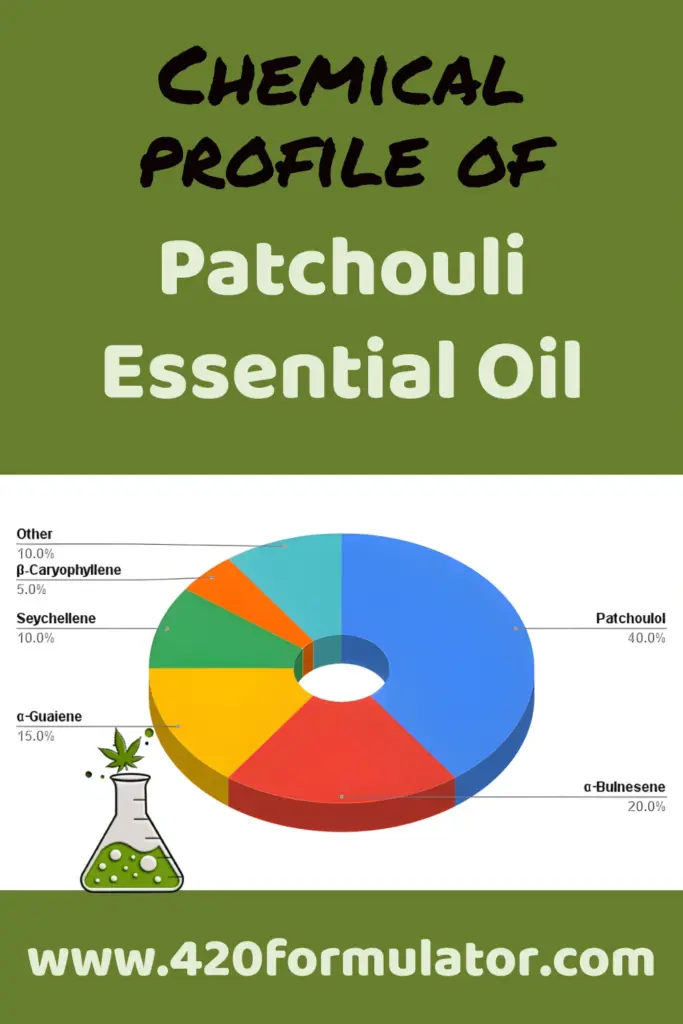
Patchouli essential oil possesses a unique chemical composition that sets it apart. It is not a bright oil built around top notes. It is a heavy, slow, grounding oil dominated by oxygenated sesquiterpenes, which explains its deep, earthy, woody aroma and the way it behaves in skincare and aromatherapy.
Patchouli oil is strongly sesquiterpene‑dominant, with very little monoterpene content. This makes it slow evaporating, long lasting, and generally well tolerated on the skin when well sourced.
Patchoulol (Patchouli alcohol)
This is the heart of Patchouli, usually around 25% to 40% and sometimes higher in the best quality oils. It’s what gives Patchouli oil its main character. It is thick, woody, earthy, slightly sweet, and profoundly regulating to the nervous system. Patchoulol promotes parasympathetic tone, which is your rest-and-repair state. It’s a big reason you feel settled, safe, and quietly content, and has a great ability to fix scents in blends.
α‑Bulnesene
Often present at roughly 10% to 20%. This sesquiterpene hydrocarbon adds dryness and structure, reinforcing the woody character and contributing to Patchouli’s tenacity without sharpness.
α‑Guaiene
Commonly around 10% to 15%. Earthy and slightly smoky, this compound contributes to the emotional weight and depth that many people associate with Patchouli.
Seychellene
Typically found at around 5% to 10%. Warm, woody, and gently balsamic, it helps round out the heavier components and smooth the overall aroma.
β–Caryophyllene
Usually present at 2% to 5%. Spicy and woody, this terpene is also common in many cannabis cultivars. Its presence helps explain why Patchouli integrates so naturally with cannabis‑infused oils and cannabinoid‑rich topical preparations. You can read much more about β-Caryophyllene in the post about 26 Cannabis Terpenes.
Norpatchoulenol and related Patchoulene Alcohols
Present in smaller but important amounts. These oxygenated compounds support skin conditioning. They contribute to Patchouli’s skin-supportive and emotionally steadying nature, especially when absorbed slowly through a cream.
What is Notably Absent
Patchouli contains very low levels of monoterpenes such as Limonene or Pinene. This matters in practice because it explains several useful characteristics:
- It is far less volatile than citrus or conifer oils.
- It is generally less irritating to the skin when used correctly.
- It oxidises more slowly than many lighter oils.
- The scent lingers and anchors essential oil blends instead of disappearing quickly.
Why This Chemistry Matters in Practice
Because Patchouli is dominated by oxygenated sesquiterpenes, it tends to be grounding rather than stimulating. It’s emotionally steadying rather than uplifting, and particularly helpful for dry, stressed, and mature skin.
From a formulation perspective, this chemistry also makes Patchouli exceptionally useful as a natural fixative and very compatible with cannabis‑infused oils and heavier carrier oils. The shared presence of sesquiterpenes, particularly β–Caryophyllene, helps create cohesion between essential oil blends and cannabinoid preparations rather than competition.
This is also why Patchouli improves with age. As harsher edges soften and the sesquiterpene alcohols integrate more fully, the oil becomes rounder, deeper, and more elegant over time.
Patchouli Essential Oil Benefits
This is where Patchouli essential oil benefits start to show up in real use. When used correctly and in appropriate amounts, Patchouli proves itself to be far more than a fragrance oil. Its value comes from reliably supporting skin function, maintaining scalp balance, and promoting emotional stability, especially during stressful times.
Patchouli Essential Oil Benefits for Skin
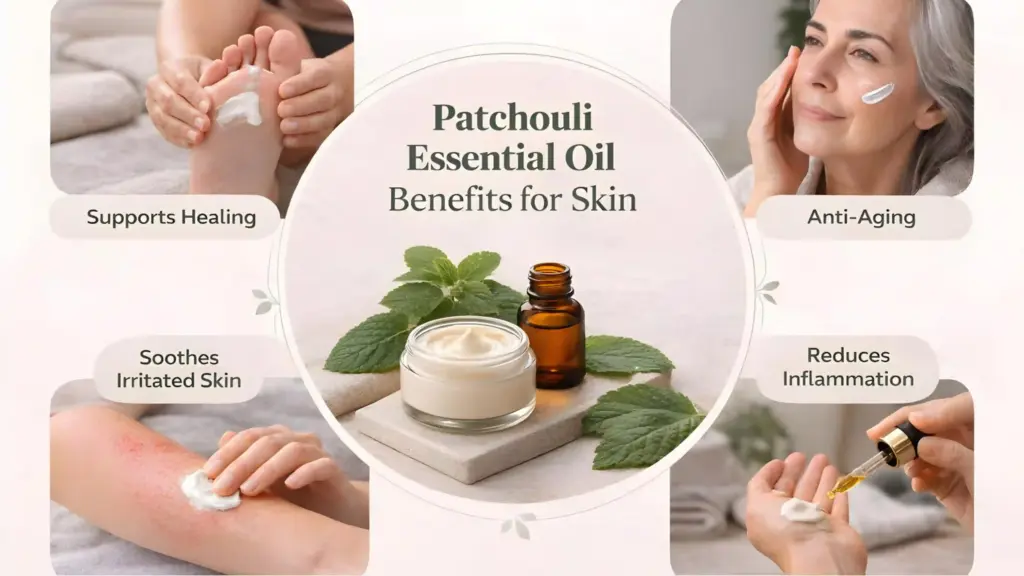
- Patchouli essential oil is ideal for skincare as it promotes the skin’s natural healing processes instead of providing temporary fixes. It tones and firms up the skin, which can make large pores look smaller, and can also smooth out fine lines as time goes on.
- One of its strongest attributes is its ability to support damaged skin. Patchouli helps regulate skin function and hydration, making it beneficial for ageing skin or skin affected by environmental stress, cold weather, or excessive cleansing. Ageing skin is often damaged skin, and Patchouli is ideal for products focused on long-term skin health instead of just quick fixes.
- Blending it with nourishing carrier oils like Tamanu oil for scar tissue or Calendula oil for soothing irritated, inflamed, or chapped skin significantly enhances its effectiveness.
- Patchouli’s antifungal and antibacterial properties make it an exceptional oil for hand creams, foot creams, and products specifically formulated for skin that undergoes frequent washing or cleansing. It would be an excellent oil to add to this DIY Cannabis Foot Cream.
- Patchouli can also be helpful for eczema-prone or acne-prone skin when used at low concentrations. Its calming and anti-inflammatory properties make it gentle, especially when paired with Fragonia™ oil, which helps soothe inflamed or reactive skin.
- Another practical benefit is its ability to mask less pleasant odours in functional formulations. Some preservatives and active ingredients do their job well, but they can smell a bit off. Patchouli is useful because it can mask odours without overpowering the overall scent of the product.
Patchouli Essential Oil Benefits for Hair
- In hair care, Patchouli essential oil is most often valued for its balancing effect on the scalp. It can help regulate sebum production in oily scalps while remaining gentle enough not to aggravate dryness or sensitivity.
- Patchouli is also useful in shampoos and body washes for its deodorising properties. It is particularly helpful if hair has been exposed to smoke or strong environmental odours. Lavender and Geranium blends are great for daily use, while Patchouli, Cedarwood, and Lavender make a deeper, grounding mix ideal for body washes.
Other Therapeutic Uses of Patchouli Essential Oil
- As a naturopath, I frequently used this oil for clients who felt anxious, down, or mentally overloaded. It has a calming effect that reduces mental chatter and alleviates feelings of being overwhelmed.
- Patchouli is especially helpful for caregivers who often feel emotionally exhausted and neglect self-care. It helps create a sense of emotional space and grounding without being sedating.
- It is also a useful insect deterrent when diffused. If bites do occur, Patchouli can help soothe irritation when applied in a well-diluted topical blend.
- Patchouli is traditionally seen as an aphrodisiac, likely due to its grounding and confidence-boosting qualities rather than any stimulating effects.
Patchouli Essential Oil in Skincare Formulations
With Patchouli, less really is more. This is an oil that works best when it supports a formulation quietly rather than drawing attention to itself.
- Typically, essential oils are often not used at more than about 1% to ensure safety. Patchouli is a very safe oil, but you really wouldn’t want to go as high as 1%, just because the scent is so strong. It’s best used in low percentages.
- In creams, lotions, and balms, Patchouli sits comfortably at low levels. Used this way, it supports skin repair, calms irritation, and helps skin settle back into a more normal rhythm. It is ideal for products for dry, damaged, or stressed skin, where gradual improvement is more important than quick results.
- Patchouli also integrates well into cannabis-infused topicals. Its terpene profile complements cannabinoid-rich oils, adding depth and stability to a formula rather than competing with other functional ingredients.
- Because the aroma is strong, Patchouli benefits from being softened by other oils. Lavender, Geranium, and Frankincense smooth its edges, while small amounts of citrus can lift a blend if needed. It is also useful when a formulation contains effective but less pleasant-smelling ingredients, as Patchouli can help pull everything together.
As with all essential oils, Patchouli should always be diluted and introduced gently. Start low, observe how the skin responds, and only adjust if there is a clear reason to do so. This approach produces better skin tolerance and far more wearable products.
Blending Suggestions With Patchouli
Patchouli is a base note, so it behaves best when you let it anchor a blend rather than trying to make it do all the work. I tend to think of it as something that holds everything together quietly in the background.
The amounts below are for diffuser or aroma blends and are intentionally restrained. Patchouli does not need much to make its presence felt.
Grounded Calm: 6 drops Patchouli, 6 drops Lavender, 4 drops Frankincense, 4 drops Sweet Orange.
Skin Comfort: 6 drops Geranium, 5 drops Patchouli, 5 drops Lavender, 4 drops Frankincense.
Deep Woods: 6 drops Cedarwood, 6 drops Lavender, 4 drops Patchouli, 4 drops Bergamot.
Quiet Evening: 7 drops Lavender, 5 drops Patchouli, 5 drops Frankincense, 3 drops Mandarin.
Warm Floral Base: 7 drops Geranium, 6 drops Frankincense, 4 drops Patchouli, 3 drops Rose Absolute.
If you are new to Patchouli, start with even fewer drops than listed and work up slowly. It is much easier to add more than to fix a blend where Patchouli has taken over. In the deeper blends, Patchouli may still read clearly on first diffusion. If you prefer it even quieter, reduce Patchouli by one drop and increase a softer oil instead.
Contraindications and Safety
Patchouli essential oil has a good safety profile when it is used sensibly and well diluted. It is generally considered suitable for sensitive skin when kept at low levels.
The main thing to be mindful of with Patchouli is not overdoing it. The scent is strong, so using too much can be overwhelming and may cause headaches or nausea for some people. This is more about comfort than toxicity, but it is still worth paying attention to.
Some sources recommend using Patchouli in very low dilutions for children, but I advise against using it for infants and children under 7 unless a qualified professional specifically recommends it.
As with all essential oils, Patchouli should never be used neat on the skin. Always dilute it with a suitable carrier oil or finished product, start with a small amount, and avoid internal use.
Chakra Associations of Patchouli
Patchouli essential oil connects well with a few chakras. It’s especially great for areas linked to stability, handling emotions, and building personal strength.
1st Chakra (Root Chakra / Muladhara)
This chakra is all about feeling safe, secure, and grounded. It’s our foundation, tied to our survival needs and sense of belonging in the world. When it’s balanced, you feel steady and anchored, able to cope with life’s ups and downs.
Location: Base of the spine
Qualities: Grounding, stability, safety
Mantra: “I am safe, grounded, and secure”
Colour: Red
Element: Earth
Stone: Red Jasper, Hematite, Black Tourmaline
Patchouli’s earthy, heavy aroma strongly supports this chakra, helping bring people back into their body when they feel scattered or overwhelmed.
2nd Chakra (Sacral Chakra / Svadhisthana)
This is your centre for pleasure, creativity, and emotional flow. It helps you connect with your feelings, sexuality, and the simple joys of life. When balanced, you’re open to new experiences and comfortable in your own skin.
Location: Lower abdomen, below the navel
Qualities: Emotions, creativity, pleasure, sexuality
Mantra: “I allow creativity and pleasure into my life”
Colour: Orange
Element: Water
Stone: Carnelian, Orange Calcite, Moonstone
Patchouli has long been associated with sensuality and emotional expression, making it a natural fit for this chakra when emotions feel blocked or dulled.
3rd Chakra (Solar Plexus Chakra / Manipura)
This chakra rules your confidence, self-worth, and personal power. It’s where you find your inner strength and the drive to set boundaries and achieve your goals. Balanced, it helps you stand tall and feel capable.
Location: Upper abdomen, stomach area
Qualities: Confidence, personal power, will, self-esteem
Mantra: “I am confident in all that I do”
Colour: Yellow
Element: Fire
Stone: Citrine, Tiger’s Eye, Yellow Jasper
Patchouli supports this chakra by helping people feel more solid and self-contained, particularly during periods of stress or emotional overload.
7th Chakra (Crown Chakra / Sahasrara)
This chakra is your connection to the universe and the higher self. It brings a sense of spiritual awareness, unity, and peace. When open, it helps you feel at one with everything, fostering wisdom and enlightenment.
Location: Top of the head
Qualities: Spiritual connection, awareness, unity
Mantra: “I am connected to the universe and open to wisdom”
Colour: Violet or White
Element: Thought (Cosmic energy)
Stone: Clear Quartz, Amethyst, Selenite
Despite being a deeply earthy oil, Patchouli can also support the crown chakra by creating a sense of grounded clarity rather than airy disconnection.
Chinese Emotions of the Organs
In Traditional Chinese Medicine, each main emotion is linked to a specific organ, so how you feel affects your body and vice versa. Keeping your emotions balanced helps keep your organs healthy, and looking after your organs supports your emotional wellbeing.
Patchouli’s grounding, settling nature makes it particularly useful where emotional overload, stagnation, or difficulty letting go are present.
Spleen
The spleen is associated with overthinking, worry, and emotional heaviness. When this system is under strain, people often feel mentally tired, stuck, or weighed down. Patchouli’s steadying quality helps bring things back into balance, especially when someone is carrying too much responsibility or mental clutter.
Heart and Colon
The heart and colon are linked with joy, love, and the ability to let go. Emotional congestion here can show up as a lack of joy, emotional tightness, or difficulty releasing what is no longer helpful. Patchouli supports this system by encouraging emotional grounding and gentle release rather than forcing change.
Spine
The spine relates to structure and flexibility, both physically and mentally. Rigid thinking or an inability to say no often accompanies tension in this area. Patchouli can help soften that rigidity, supporting a more grounded sense of personal boundaries and emotional resilience.
Conclusion
Patchouli essential oil benefits go well beyond its reputation as a strong or divisive scent. When used carefully, it is a dependable oil that aids skin repair, emotional stability, and overall balance.
In skincare, Patchouli earns its place through consistency rather than drama. It’s great for skin that’s been damaged, stressed out, or just getting older. A small amount is effective, and it mixes easily into creams, lotions, and cannabis products. Aromatically, it offers grounding and calm, particularly for people who feel mentally overloaded or emotionally stretched.
Patchouli is not an oil to overuse or show off. It works best when it is allowed to do its job quietly in the background. Used that way, it remains one of the most dependable and versatile essential oils available.
🎧 Listen Instead
 Spotify
 YouTube
FAQ
What is patchouli essential oil?
Patchouli essential oil is a steam-distilled oil made from the fermented leaves of the patchouli plant (Pogostemon cablin). It has a deep, earthy aroma and is commonly used in skincare, aromatherapy, and perfumery.
What is patchouli essential oil used for?
Patchouli essential oil is commonly used to support irritated or damaged skin, help skin retain moisture, and provide a grounding, calming effect in aromatherapy. It is also used in hair care products and emotional support blends.
Is patchouli essential oil good for skin?
Yes, when used correctly and well diluted, Patchouli is particularly well suited to skincare. It supports skin repair, helps calm inflammation, and is often used in products for dry, stressed, or ageing skin.
Does patchouli essential oil smell very strong?
Patchouli has a strong aroma, but it does not need to be overpowering. Used in small amounts and blended well, it becomes warm, earthy, and grounding rather than heavy or intrusive.
Is patchouli essential oil safe to use?
Patchouli essential oil has a good safety profile when used externally and diluted properly. It should never be applied neat to the skin and should not be taken internally unless under medical supervision.
Can patchouli essential oil be used for stress or anxiety?
Many people use patchouli for its calming and grounding qualities. It is often chosen when someone feels mentally overloaded, anxious, or emotionally worn down, as it helps create a sense of steadiness rather than stimulation.