
Cannabis topicals are one of the most practical ways to use infused oils in natural skincare. They sit beautifully alongside aromatherapy, carrier oils, butters, waxes, emulsifiers and essential oils, which makes them a natural fit for home formulation.
At 420formulator, cannabis topicals are not just about rubbing weed into a jar of oil and hoping for the best. They are about understanding what each ingredient is doing, choosing the right type of product for the job, and making creams, balms, oils and skincare formulas that feel good on the skin.
Table of Contents
This guide is your starting point. We’ll look at what cannabis topicals are, the difference between balms and lotions, how infused oils fit into skincare, which ingredients matter, and where to go next if you want to make your own cannabis creams, salves, cleansers and body products at home.
If you would like to see how topicals fit alongside tinctures, edibles and infused oils, start with my DIY cannabis products guide.
What Are Cannabis Topicals?
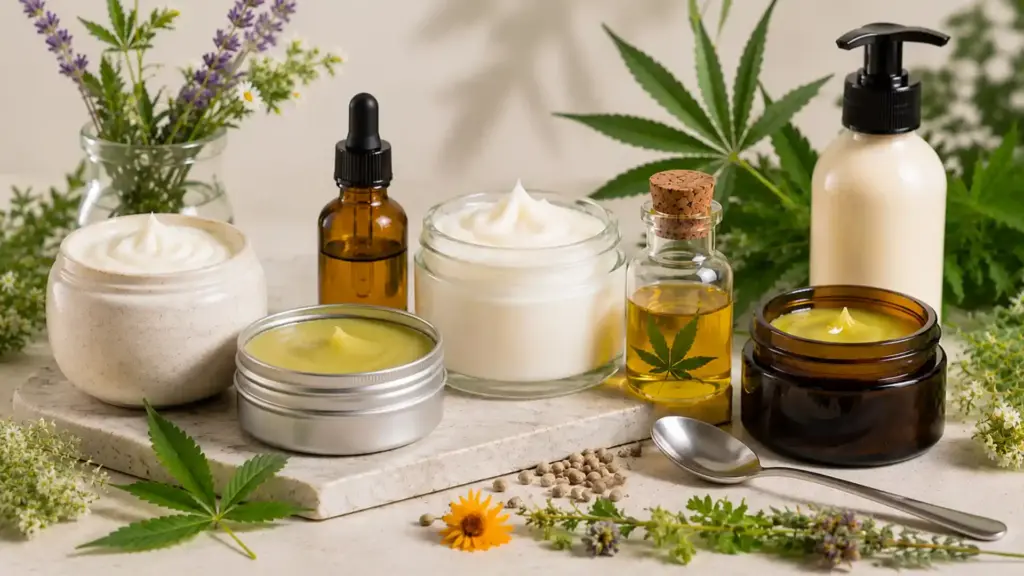
Cannabis topicals are skincare products made with cannabis-infused ingredients and applied directly to the skin. They can be simple, like a balm made with infused oil and beeswax, or more advanced, like an emulsified lotion made with water, oils, emulsifiers and preservatives.
Common cannabis topical products include:
- Cannabis balms
- Cannabis salves
- Cannabis body butters
- Cannabis-infused oils
- Cannabis lotions
- Cannabis creams
- Cannabis foot creams
- Cannabis massage oils
- Cannabis cleansers
- Cannabis skincare blends with essential oils
The word “topical” simply means the product is used on the surface of the body. Unlike edibles or inhaled cannabis, topicals are not designed to be eaten, smoked or vaped. They are designed for skin application.
That makes formulation important. A good cannabis topical needs to be pleasant to use, stable, safe for the skin, and made with ingredients that make sense together.
Why Cannabis Works So Well in Skincare Formulation
Cannabis fits naturally into skincare because it is usually carried in oil. Many cannabis preparations start with an infused carrier oil such as olive oil, grapeseed oil, sunflower oil, coconut oil, rice bran oil, hemp seed oil or another skin-friendly vegetable oil.
That infused oil then becomes part of the formula.
- In a balm, it may provide most of the oily phase.
- In a cream or lotion, it becomes part of the oil phase.
- In a cleanser, it may be combined with lighter oils and emulsifiers.
- In a massage oil, it may be blended with essential oils and other carrier oils.
This is why cannabis topicals sit so neatly between herbalism, aromatherapy and cosmetic formulation. You are not just working with cannabis. You are working with the whole structure of a skincare product.
The cannabis-infused oil matters, but so do the supporting ingredients.
Cannabis Balms, Creams, Lotions and Oils: What’s the Difference?
One of the easiest ways to understand cannabis topicals is to separate them by product type.
Cannabis Balms and Salves
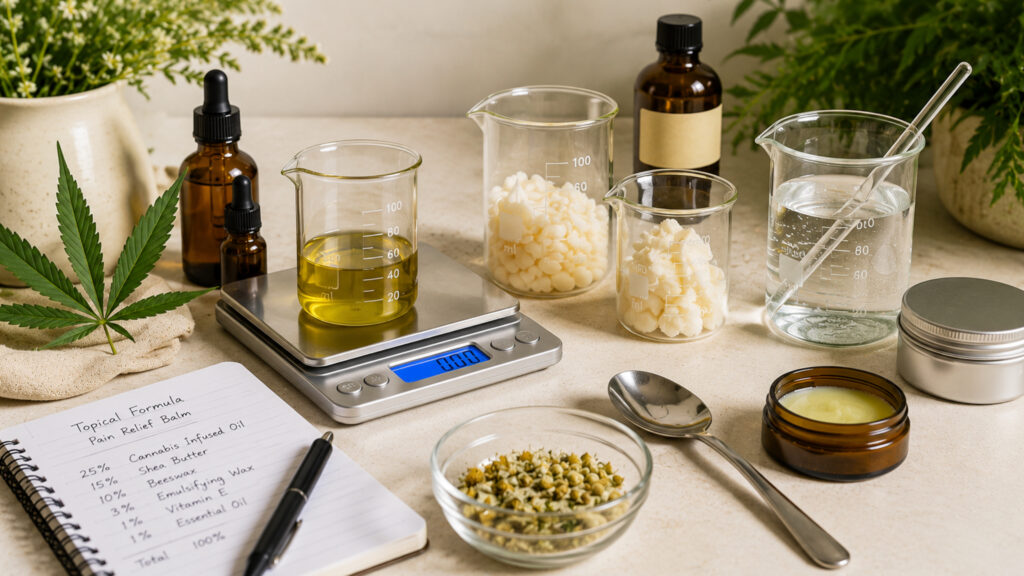
Cannabis balms and salves are usually oil-based products. They often contain infused oil, waxes and butters. They do not contain water.
That makes them simpler to make than lotions because they usually do not need an emulsifier or a broad-spectrum preservative.
A basic cannabis balm might include:
- Cannabis-infused oil
- Beeswax or a plant wax
- Shea butter, cocoa butter or mango butter
- Optional essential oils
- Optional vitamin E
Balms are rich, protective and long-lasting on the skin. They are good when you want an occlusive, nourishing product that stays in place.
They can feel greasy if overloaded with heavy oils or waxes, so balance matters.
Cannabis Creams and Lotions
Cannabis creams and lotions are emulsions. That means they contain both water and oil, held together with an emulsifier.
A cannabis lotion might contain:
- Water or hydrosol
- Cannabis-infused oil
- Other carrier oils
- An emulsifier
- A thickener or stabiliser
- Humectants such as glycerin
- A preservative
- Optional actives
- Optional essential oils
Creams and lotions feel lighter than balms because they contain water. They can be more elegant, more moisturising, and easier to spread over larger areas.
But they also require more care. Once a formula contains water, it needs proper preservation. This is not optional. Water-based products can grow bacteria, yeast and mould if they are not preserved correctly.
That does not mean lotions are frightening. It simply means they need to be made properly.
Cannabis-Infused Oils
Cannabis-infused oils are the foundation of many topical formulas. They can also be used on their own as massage oils, body oils or as the oil phase in another product.
Your choice of carrier oil changes the skin feel.
- A light oil may suit facial or body products.
- A richer oil may suit dry skin, foot creams or balms.
- A more stable oil may be better for heating or longer shelf life.
The cannabis infusion is only one part of the finished product. The carrier oil itself brings texture, absorption, stability and skin benefits.
Cannabis Body Butters
Body butters sit somewhere between balms and creams. Some are anhydrous, meaning they contain no water. These are made from oils, butters and waxes, and can be whipped or poured.
They are richer than creams and can be lovely for dry skin, elbows, knees, feet and body care.
They can also become too greasy or grainy if the butter balance is wrong, so the formulation still matters.
Cannabis Cleansers
Cannabis cleansers are less common, but they can be very interesting. A cannabis-infused oil can be used in an oil cleanser, balm cleanser or emulsifying cleanser.
This is where formulation becomes more creative. You are not just making something that stays on the skin. You are making something that lifts away oil, sunscreen, dirt or makeup, then rinses clean.
That usually means thinking about emulsifiers, surfactants or rinse-off behaviour.
CBD, THC and Full-Spectrum Cannabis in Topicals
Cannabis topicals may be made with CBD-rich, THC-rich or full-spectrum infused oils, depending on the material you are using and the laws where you live.
For skincare formulation, the bigger practical question is often:
- What kind of infused oil are you using?
- How strong is it?
- What carrier oil is it infused into?
- How much of it can the formula comfortably hold?
- Does the final product still feel good on the skin?
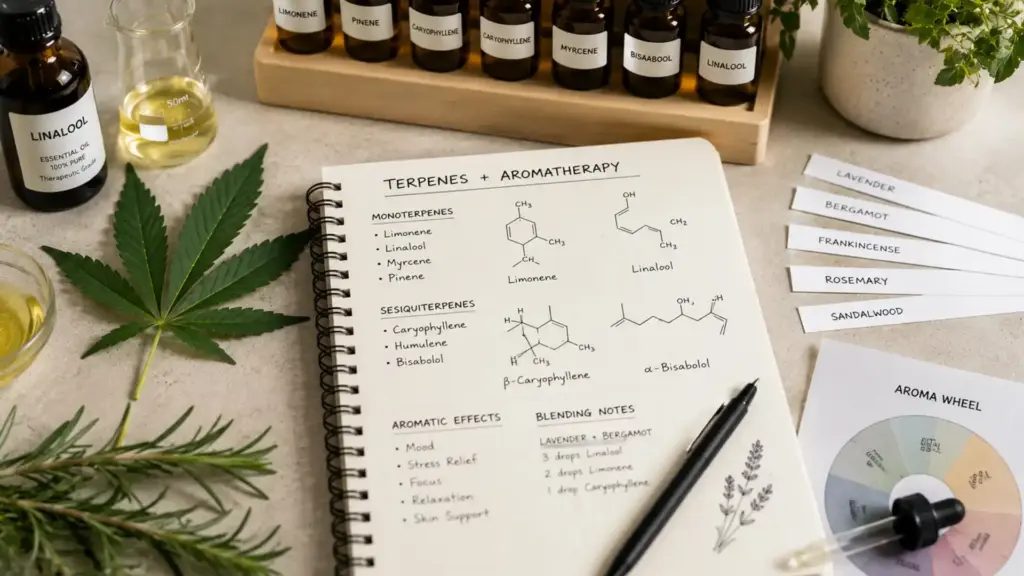
CBD and THC are cannabinoids, but cannabis also contains terpenes and other plant compounds. These can contribute to the character of an infused oil, especially when working with whole-plant preparations.
Research into topical and transdermal cannabinoids is still developing, but reviews on skin delivery show why formulation, carrier choice and skin barrier behaviour matter.
However, it is important not to overpromise. Cannabis topicals are not magic cure-alls. The broader evidence base for cannabis and cannabinoids is still mixed, so it is better to discuss homemade topicals as skincare and formulation products rather than medical treatments.
On this site, we look at them as skincare and formulation products first: how they feel, how they are made, how the ingredients work together, and how to use them sensibly.
The Role of Terpenes in Cannabis Topicals
Terpenes are aromatic compounds found in cannabis, essential oils, herbs, fruits, resins and many other plants. They contribute scent, character and in some cases the traditional use profile of an ingredient.
This is one reason cannabis and aromatherapy belong in the same conversation.
Cannabis contains terpenes such as myrcene, beta-caryophyllene, limonene, linalool and pinene. Essential oils also contain many of these same or related aromatic compounds.
That does not mean you should randomly add strong essential oils to every cannabis balm. It means you can formulate more intelligently when you understand the aromatic chemistry.
For example:
Lavender essential oil is naturally associated with linalool and linalyl acetate.
Black pepper and copaiba are often discussed for beta-caryophyllene.
Citrus oils are rich in limonene, though some citrus oils can be phototoxic depending on the type and how they are produced. This is especially important with some expressed citrus oils, where phototoxicity can be a real formulation concern.
Peppermint contains menthol and has a very strong cooling sensation, so it needs careful dilution.
Tea tree has a sharp, medicinal profile and is often used in problem-skin formulations, but it also needs proper safety awareness.
Essential oils can make a cannabis topical feel more purposeful and aromatic, but they must be used at safe levels. More is not better. Skin irritation is not a badge of potency.
Essential Oils in Cannabis Skincare
Essential oils can bring scent, character and formulation direction to cannabis skincare. They can help turn a plain infused balm into something that feels more complete.
But essential oils are concentrated ingredients. They are not decorations. For dermal use, dilution matters: essential oil safety guidance consistently treats neat or excessive use as a higher irritation and sensitisation risk.
Before adding essential oils to a cannabis topical, think about:
- The purpose of the product
- The area of the body
- The age and skin sensitivity of the user
- The total dilution
- Whether the product is leave-on or rinse-off
- Any phototoxicity concerns
- Whether the scent suits the formula
- Whether the oil makes sense with the carrier oils and cannabis infusion
For facial products, keep essential oil levels low or leave them out entirely if the skin is reactive.
For foot creams, body balms or massage oils, you may have more room to create a stronger aromatic profile, but safety still comes first.
Cannabis skincare does not need to smell like a hippie cupboard from 1978. It can be elegant, subtle, herbal, resinous, floral, citrusy or completely unscented.
Carrier Oils for Cannabis Topicals
Carrier oils do a lot of the heavy lifting in cannabis skincare. They affect absorption, texture, stability, skin feel and the final character of the product.
Some useful carrier oils for cannabis topicals include:
Grapeseed Oil
Grapeseed oil is light, easy to work with and popular in infused oils. It gives a less greasy feel than some heavier oils, though it is not the most oxidation-resistant oil.
Olive Oil
Olive Oil is traditional, accessible and stable enough for many herbal infusions. It is richer and heavier, which can be useful in balms but may feel too oily in some lotions.
Rice Bran Oil
Rice Bran Oil is a useful skincare oil with a smooth feel and good formulation flexibility. It can suit cannabis infusions, body products and nourishing skincare.
Hemp Seed Oil
Hemp Seed Oil has a beautiful fatty acid profile, but it is delicate and prone to oxidation. It is usually better used carefully in cool-down phases or shorter shelf-life products rather than heavily heated formulas.
Sunflower Oil
Sunflower Oil is versatile, accessible and skin-friendly. High-oleic sunflower oil is more stable than regular sunflower oil and can be useful in creams and balms.
Apricot Kernel Oil
Apricot Kernel Oil has a soft, elegant skin feel. It works nicely in face and body formulations where you want something lighter than olive oil.
Meadowfoam Seed Oil
Meadowfoam Seed Oil is valued for its stability and silky feel. It can help improve the skin feel of a formula and support longer-lasting oil blends.
The best carrier oil is not always the fanciest one. It is the one that suits the product, the skin feel, the infusion method and the shelf-life you need.
Butters and Waxes in Cannabis Balms
Butters and waxes give cannabis balms their structure.
Common choices include:
- Shea Butter
- Cocoa Butter
- Mango Butter
- Beeswax
- Soy Wax
- Rice Bran Wax
Waxes firm the balm. Butters add richness and body. Oils soften the formula and carry the infusion.
The balance matters. Too much wax and the balm drags. Too much soft oil and it melts into a puddle. Too much brittle butter and the texture may become grainy or hard.
A well-made cannabis balm should glide, soften on contact and leave the skin feeling protected without feeling like you have dipped yourself in candle polish.
Emulsifiers in Cannabis Creams and Lotions
If you want to make a cannabis cream or lotion, you need an emulsifier. This is what allows water and oil to stay blended together.
Without an emulsifier, water and oil separate.
Different emulsifiers create different textures. Some are lighter. Some are richer. Some are more conditioning. Some work better in body creams, others in facial lotions or hair products.
For cannabis lotions, emulsifiers are especially useful because they allow your infused oil to become part of a more elegant moisturising product.
This is where formulation starts to move beyond kitchen craft and into proper cosmetic making. That is not a bad thing. It simply means you have more control.
Preservatives: The Bit You Should Not Skip
Any cannabis topical that contains water needs a suitable broad-spectrum preservative. Water-containing cosmetics need preservation because water, nutrients and repeated use can create conditions where microbes can grow.
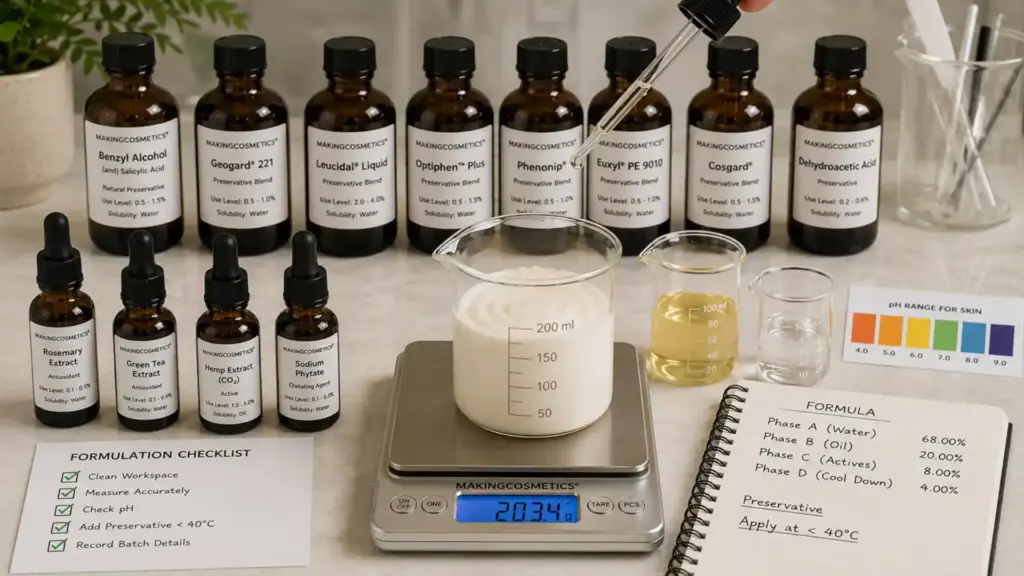
That includes products made with:
- Water
- Hydrosols
- Aloe vera juice
- Herbal teas
- Glycerites diluted into water
- Water-based actives
- Milks or fresh ingredients
If there is water in the formula, microbes can grow. A preservative helps protect the product during normal use.
Anhydrous balms and oils do not usually need a broad-spectrum preservative because they do not contain water. They may still benefit from antioxidants such as vitamin E to slow oxidation, but antioxidants are not preservatives. They do not protect against bacteria, yeast or mould.
This distinction matters.
Vitamin E can help slow rancidity in oils.
A preservative helps protect a water-containing product from microbial growth.
They are not the same job.
Safety-Aware Cannabis Skincare
A good cannabis topical should be made with common sense.
Here are the basics:
- Patch test new products.
- Avoid broken or irritated skin unless the formula is specifically designed and assessed for that situation.
- Be careful with essential oils, especially on the face, around children, during pregnancy, around pets, or with sensitive skin.
- Do not add random kitchen ingredients to preserved creams.
- Do not put water, herbal tea or aloe into an oil balm and assume it will be fine.
- Label your products clearly.
- Keep notes on your formula.
- Use clean equipment.
- Avoid making medical claims about homemade skincare.
- If a product smells odd, changes texture, grows visible mould, separates badly or irritates the skin, stop using it.
- A homemade topical can be beautiful, but it should never be treated casually just because it is natural.
Natural ingredients can still irritate the skin. Essential oils can still sensitise. Water-based products can still spoil. Cannabis does not magically override formulation rules.
Choosing the Right Cannabis Topical for the Job
Different products suit different situations.
- If you want something simple and rich, start with a balm.
- If you want something lighter and more moisturising, make a lotion.
- If you want a massage product, use an infused oil blend.
- If you want something for dry heels or rough skin, use a richer cream or balm.
- If you want facial skincare, keep the formula elegant, light and carefully scented or unscented.
- If you want a rinse-off product, think about cleansers rather than leave-on balms.
The formula should match the purpose.
A foot cream does not need to behave like a facial serum. A balm does not need to pretend to be a lotion. A cannabis cleanser needs a different structure from a massage oil.
That is what formulation gives you: control.
Beginner-Friendly Cannabis Topical Ideas
If you are new to cannabis skincare, start simple.
Cannabis-Infused Body Oil
This is one of the easiest starting points. Use a cannabis-infused carrier oil, then blend it with other skin-friendly oils to improve texture and skin feel.
You can use it as a body oil or massage oil.
Cannabis Balm
A balm is a good beginner formula because it does not contain water. You will learn how oils, butters and waxes behave without dealing with emulsification or preservation.
Cannabis Foot Cream
A foot cream is a useful next step because it can be richer and more forgiving than a facial product. Ingredients such as urea, glycerin and nourishing oils can make it more purposeful.
Cannabis Lotion
A lotion is more advanced because it is an emulsion. It is worth learning because it gives a much more elegant skin feel than a balm.
Cannabis Oil Cleanser
A cleanser is a lovely route if you enjoy facial skincare, but it requires thinking about rinse-off behaviour and emulsifiers.
How to Build a Cannabis Topical Formula
A good formula starts with a clear purpose.
Ask yourself:
- What is this product for?
- Where will it be used?
- Is it leave-on or rinse-off?
- Is it for the face, body, hands or feet?
- Should it be light, rich, firm, whipped, creamy or oily?
- Will it contain water?
- Does it need a preservative?
- What cannabis-infused ingredient am I using?
- What other ingredients support the formula?
Then build the formula around that purpose.
For a balm, you might think in terms of:
- Infused oil
- Additional oils
- Butters
- Waxes
- Optional essential oils
- Optional antioxidant
For a lotion, you might think in terms of:
- Water phase
- Oil phase
- Emulsifier
- Thickener
- Humectant
- Cool-down ingredients
- Preservative
- Optional essential oils
For a cleanser, you might think in terms of:
- Oil phase
- Emulsifier or surfactant system
- Rinse-off feel
- Skin after-feel
- Scent and irritation potential
Once you understand the product type, you stop guessing and start formulating.
Where Cannabis Skincare Meets Aromatherapy
Aromatherapy can add another layer to cannabis skincare, but it works best when it is used with restraint.
A cannabis balm with a little lavender, frankincense and black pepper will feel very different from one with peppermint, rosemary and eucalyptus.
A facial oil with a trace of chamomile or rose-like aromatics will feel very different from a strong mentholated body balm.
The essential oil blend should match the product.
For example:
- A calming body oil may suit lavender, frankincense or sweet orange.
- A foot cream may suit tea tree, peppermint or lavender at sensible levels.
- A muscle-style balm may use warming or cooling aromatic notes, but the dilution must still be skin-safe.
- A facial product may be better with no essential oils at all.
Cannabis and essential oils can work beautifully together, but they need formulation discipline.
Common Mistakes in Cannabis Topicals
The most common mistakes are simple ones.
- Adding too much essential oil.
- Using a water ingredient without a preservative.
- Assuming vitamin E is a preservative.
- Making a cream or lotion without understanding emulsifiers.
- Using too much wax and making a balm that drags.
- Using delicate oils in a high-heat infusion without thinking about oxidation.
- Putting strong essential oils in facial products.
- Making medical claims that a homemade skincare product cannot support.
- Failing to label the product.
- Not writing down the formula.
The good news is that all of these are avoidable.
How This Site Can Help You Make Better Cannabis Topicals
The 420 Formulator is here to help you move from “I mixed some infused oil into something” to “I understand what this formula is doing.”
You will find guides on cannabis lotions, balms, carrier oils, essential oils, emulsifiers, preservatives, actives, cleansers and natural skincare ingredients.
Start with the type of product you want to make, then follow the ingredient trail.
If you want to make a proper lotion, learn about emulsifiers and preservatives.
If you want to make a balm, learn about oils, butters and waxes.
If you want to use essential oils, learn about safe dilution and aromatic synergy.
If you want to improve skin feel, learn about carrier oil choice.
If you want to make cannabis skincare that feels genuinely good, learn the formula rather than just copying the recipe.
Recommended Guides to Read Next
If you want to start making cannabis skincare, these are good places to go next:
Make Cannabis Lotion at Home: CBD Cannabis Topicals Simplified
Use this when you are ready to make a proper emulsified cannabis lotion.
DIY Cannabis Foot Cream with Urea for Dry, Cracked Heels
A richer, more targeted foot cream formulation for feet and dry skin.
Rice Bran Oil for Skin, Haircare, and Cannabis Infusions
Useful if you want to understand a heat-stable carrier oil like Rice Bran Oil for cannabis skincare.
Unlocking the Power of Oat Oil Cannabis Skincare
A good blog post on Oat Oil for barrier-focused skincare formulas.
Lavender Essential Oil Benefits for Skin and Aromatherapy Blends
Helpful if you want to use Lavender Essential Oil to bring aromatherapy into cannabis skincare safely and thoughtfully.
Essential Oils for Cannabis Skincare
A broader look at essential oils that can pair well with cannabis topicals.
Conclusion
Cannabis topicals can be simple or sophisticated. A basic balm can be useful. A well-made lotion can feel elegant. An infused oil can become the starting point for dozens of different skincare products.
The key is to understand the product you are making.
- Balms need good oil, butter and wax balance.
- Lotions need emulsifiers and preservatives.
- Essential oils need safe dilution.
- Carrier oils need to suit the skin feel and purpose.
- Cannabis-infused ingredients need to be treated as part of a proper formula, not as a magic addition.
Once you understand those basics, cannabis skincare becomes much easier, much safer and much more satisfying to make.
This is where cannabis topicals, aromatherapy and natural formulation come together: practical, grounded, skin-friendly products that make sense from the first ingredient to the final jar.
🎧 Listen Instead
 Spotify
 YouTube
FAQ
What are cannabis topicals?
Cannabis topicals are products made with cannabis-infused ingredients and applied to the skin. They include balms, salves, creams, lotions, oils, massage blends, cleansers and body products.
Do cannabis topicals get you high?
Most cannabis topicals are not designed to produce the same effect as eating or inhaling cannabis. They are applied to the skin and used as skincare or body care products. Always label products clearly and use them responsibly.
What is the easiest cannabis topical to make?
A simple cannabis balm or infused body oil is usually the easiest place to start. These products do not contain water, so they are simpler than creams and lotions.
Do cannabis lotions need a preservative?
Yes, if the lotion contains water, hydrosols, aloe vera juice or other water-based ingredients, it needs a suitable broad-spectrum preservative.
Is vitamin E a preservative?
No. Vitamin E is an antioxidant. It can help slow oil oxidation, but it does not protect water-based products from bacteria, yeast or mould.
Can I add essential oils to cannabis topicals?
Yes, but they must be used carefully and at skin-safe levels. Essential oils are concentrated and can irritate the skin if overused.
What is the difference between cannabis balm and cannabis lotion?
A cannabis balm is usually oil-based and contains oils, butters and waxes. A cannabis lotion contains water and oil blended together with an emulsifier, so it feels lighter but needs proper preservation.
What carrier oil is best for cannabis skincare?
There is no single best carrier oil. Grapeseed, olive, rice bran, sunflower, apricot kernel, hemp seed and meadowfoam can all be useful depending on the formula, skin feel and stability you want.
Can I use cannabis-infused oil on my face?
You can, but choose your carrier oil carefully and avoid heavy or comedogenic formulas if your skin is prone to congestion. Facial products should usually be lighter and more restrained with essential oils.
Should cannabis skincare be scented?
It can be scented, but it does not have to be. Unscented formulas are often better for sensitive skin, while carefully chosen essential oils can add aroma and character to body products, balms and massage oils.