
Natural preservatives in cosmetics are not as straightforward as the name suggests. Some are naturally derived, some are accepted in certified natural cosmetics, and others are synthetic preservatives that many natural formulators use as a practical compromise. Those descriptions are not interchangeable.
In this guide, I look at four preservative systems I have used or considered, including Euxyl® PE 9010, which is synthetic but remains a reliable choice. More important than whether a preservative sounds natural is whether it suits the product, works within its pH range and provides suitable protection against bacteria, yeast and mould.
Table of Contents
*As an Amazon Associate, I earn from qualifying purchases
I remember a certain cosmetic seminar I attended, and there was this one guy who just suddenly stood up and started ranting. He was really over it with all these “green, eco-hippies” whining about pesticides and herbicides! It was unexpected, to say the least! He went on to say that if you want to avoid herbicides and pesticides completely, then you might as well embrace the oil industry and the chemicals found in cosmetics.
This shocked the audience at the organic cosmetics conference, but Mr Angry made a valid, though uncomfortable, point. Crude oil formed from ancient organic material over millions of years, long before modern herbicides and pesticides existed. By his logic, ingredients made from it could claim a natural origin without any of the agricultural chemicals people were objecting to. His argument was deliberately provocative, but it exposed how slippery the word “natural” can be.
Does Natural Mean Unprocessed?
Take German Chamomile Essential Oil. Surely everyone would call that natural? Yet Chamazulene, the constituent that gives the oil its deep blue colour, is not present in that form in the living flower. It is created from matricin during steam distillation. The finished oil is still natural, but the process has changed its chemistry. So perhaps “unprocessed” is not a useful definition either.
I’m not going to pretend there is one tidy answer, because there isn’t. With natural preservatives in cosmetics, you have to decide where you sit on the scale and be honest about it. My own priority is making something properly preserved, pleasant to use and honest about what is in it.
Preservation becomes essential when cannabis creams and lotions contain water, aloe, hydrosols or botanical extracts. The four systems below include preservatives accepted in natural formulations and synthetic options I consider a sensible compromise. That will not suit every definition of natural, but I would rather make that compromise than put an inadequately preserved cream in a jar.
Euxyl® PE 9010
Euxyl® PE 9010 is a liquid, broad-spectrum preservative containing around 90% Phenoxyethanol and 10% Ethylhexylglycerin. It is synthetic rather than a certified natural preservative, but I still use it in natural skincare formulations as a practical compromise. It is reliable against Gram-positive and Gram-negative bacteria, yeast and mould, easy to work with and widely compatible. Some suppliers sell it as Plantaserve E.
It is stable across a wide pH range from 3 to 12 and can be used in emulsions, gels, washes and wipes. It is compatible with many anionic and non-ionic surfactants, although high levels of ethoxylated surfactants can reduce its effectiveness. Its limited solubility in water is worth remembering, particularly in very watery products.
The manufacturer’s usual use level is 0.5% to 1.0% of the finished formula. For most applications, I use 1%, going to 1.1% when I am working with a herbal infusion or decoction. Euxyl® PE 9010 is heat tolerant, but I still add it during the Cool Phase to minimise evaporation. Keep it tightly sealed, protected from light and stored in a cool, dry place.
In my experience, a well-made product preserved this way can last for 12 to 18 months, although only testing can confirm the shelf life of a particular formula.
Geogard® ECT
Geogard® ECT is a liquid, broad-spectrum preservative with the INCI Benzyl Alcohol (and) Salicylic Acid (and) Glycerin (and) Sorbic Acid. It is also sold as Preservative Eco, Mikrokill Eco and Plantaserve M. Geogard® ECT is not itself organic, but it is approved as a raw material that can be used in COSMOS-certified natural and organic cosmetics.
It is water-soluble and the manufacturer describes it as low odour and low colour. I agree about the colour. The odour is a matter of opinion! Its status can be checked in the official COSMOS listing.
It works between pH 3 and 8, which covers most creams, lotions, gels and cleansers. It can also be used in surfactant products, including formulas containing Decyl Glucoside, provided the finished pH sits within that range. Because it contains Salicylic Acid, it should not be used in products for children under three, except shampoos.
Salicylic Acid can react with traces of iron and turn a cream pink or purple. Patchouli Essential Oil can bring iron into a formula when it has been distilled or stored in iron equipment. If a cream changes colour after Patchouli has been added, it does not automatically mean that the preservative has failed. Choosing an oil distilled in stainless steel helps avoid the problem.
Use Geogard® ECT at 0.6% to 1% of the finished formula. I normally use 1%. Add it during the Cool Phase below 45°C and store it tightly sealed in a cool, dry place.
In my experience, a well-made product preserved with Geogard® ECT can last for 12 to 18 months, although only testing can confirm the shelf life of a particular formula.
Saliguard® PCG / Plantaserve P
Saliguard® PCG is another synthetic preservative that I’m happy to use as a practical compromise. Its INCI is Phenoxyethanol (and) Caprylyl Glycol (and) Propylene Glycol, and some suppliers sell it as Plantaserve P. It provides broad-spectrum protection against bacteria, yeast and mould, with little or no noticeable odour. This makes it useful when I don’t want the preservative interfering with the fragrance of the finished product.
It is a versatile choice for leave-on creams and lotions as well as rinse-off products such as shampoos, shower gels and conditioners. It works with anionic, cationic and non-ionic systems and is water-soluble.
Use Saliguard® PCG at 0.5% to 1% of the finished formula. It works between pH 3 and 10 and tolerates temperatures up to 60°C, although I add it during the Cool Phase when making an emulsion. Store it tightly sealed in a cool, dry place.
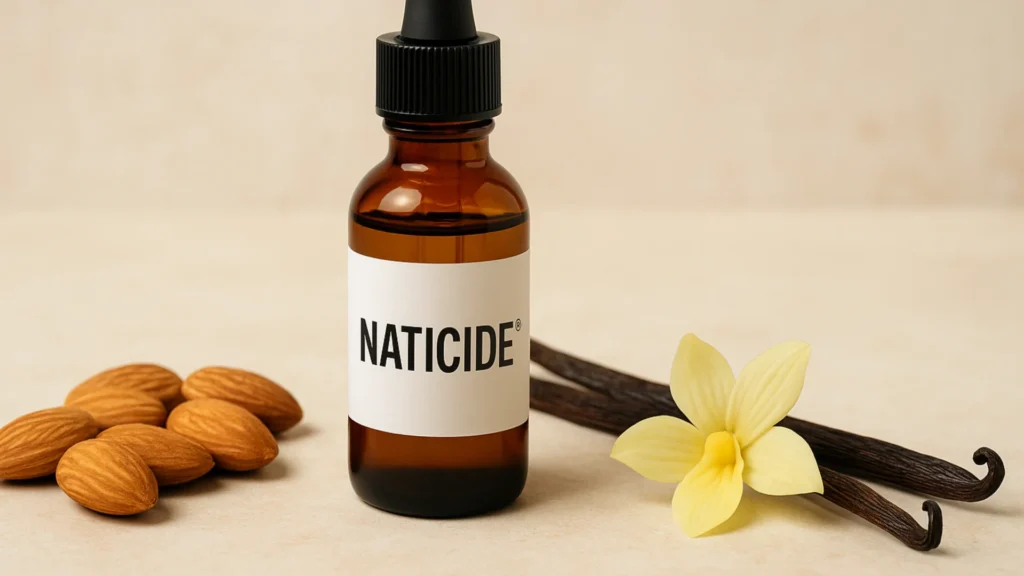
Naticide®
Naticide® is one of those ingredients that causes plenty of debate in natural formulation. It is a liquid, plant-derived antimicrobial system with the INCI Parfum. That can look like an ordinary fragrance on an ingredient list, but Naticide® provides broad-spectrum protection against Gram-positive and Gram-negative bacteria, yeast and mould.
The exact blend is proprietary. The manufacturer does not say that it is made from almonds and vanilla plants, only that it has a sweet, vanilla-like fragrance. To my nose, it smells more like vanilla and almonds, and it is certainly noticeable. It works nicely in a cream where that fragrance belongs, but I would not choose it for anything unscented or for a fresh herbal or citrus blend.
Naticide® is not listed as a conventional preservative in Annex V of the EU Cosmetics Regulation, so it appears on the ingredient list as Parfum. That is why it can turn up in products marketed as preservative-free, even though it is there to control microbial growth. It may be technically correct, but I don’t think it is particularly transparent.
Naticide® appears in the official COSMOS database as an approved raw material for use in COSMOS-certified formulations. This does not mean that Naticide® itself is organic.
Use Naticide® at 0.3% to 1% of the finished formula. It works between pH 4 and 9 and can be used in creams, lotions, gels and surfactant products. I add it during the Cool Phase and store it tightly sealed in a cool, dry place.
Is Glycerin a Natural Preservative?
No, it’s not, at least not at the amount most of us would normally use. I know that sounds like a politician’s answer. At very high levels, glycerin ties up enough available water to make life difficult for microbes. It is the lack of available water that matters, not glycerin’s sweetness. The catch is that levels high enough to help preserve a formula can feel sticky, and the result depends on the complete recipe.
Sucragel AOF is a useful exception. It is a glycerin-rich, cold-process emulsifier used to turn vegetable oils into clear gel-to-milk cleansers. It is sold as preservative-free, but that is a feature of Sucragel AOF itself. It does not mean that adding glycerin will preserve an ordinary cream or lotion.
Vitamin E causes similar confusion. This Solid Facial Oil contains butters, oils and Vitamin E. Vitamin E is an antioxidant. It helps slow oxidation and rancidity, but it does nothing to stop bacteria, yeast or mould. The formula does not need a broad-spectrum preservative because it contains no water, not because it contains Vitamin E.
Conclusion
After years of formulating, I no longer think “Is it natural?” is the most useful question to ask about a preservative. When choosing natural preservatives in cosmetics, I want to know whether one suits the formula, works at the finished pH, is compatible with the other ingredients and provides proper protection. A badly preserved natural cream is not kinder to anyone.
Euxyl® PE 9010 and Saliguard® PCG are synthetic compromises. Geogard® ECT is approved for use in COSMOS-certified formulations, while Naticide® is plant-derived and COSMOS-approved but appears on the ingredient list as Parfum. None of them fits every definition of natural, and none is right for every product.
For me, honest formulation means being clear about those compromises and choosing what works, not what sounds nicest on the label. The best preservative is one that suits your formula, does its job and leaves you with a product you would be happy to use yourself.
Preservation is one part of getting a formula right. My Skincare Formulation Essentials guide explains how it fits alongside your emulsifier, actives and the way you prepare the product.
🎧 Listen Instead
 Spotify
 YouTube
FAQ
What are natural preservatives in cosmetics?
There is no single agreed definition. The term is generally used for plant-derived or fermentation-based ingredients and for preservative systems approved for use in certified natural cosmetics. Synthetic preservatives such as Euxyl® PE 9010 may still be used by natural formulators as practical compromises, but they are not natural preservatives.
Do natural preservatives work as well as synthetic ones?
They can, but natural does not automatically mean weaker and synthetic does not mean foolproof. What matters is choosing a preservative that suits the formula, using it at the correct level and keeping the finished product within its working pH range. Only testing can show how well it performs in that particular product.
What are examples of natural preservatives for skincare?
Geogard® ECT and Naticide® are approved for use in COSMOS-certified formulations, although neither is organic. Euxyl® PE 9010 and Saliguard® PCG are synthetic preservatives that some natural formulators accept as practical compromises. The right choice depends on the product, its finished pH and the other ingredients in the formula.
Can I make preservative-free natural skincare at home?
Yes, provided the formula contains no water. Balms, facial oils and other completely oil-based products do not usually need a broad-spectrum preservative. Once you add water, aloe, a hydrosol or a herbal infusion, the product needs a suitable preservative.
Is vitamin E a preservative in cosmetics?
No, vitamin E is an antioxidant. It slows oil oxidation but does not prevent bacteria, yeast, or mould growth.
How do I choose the right natural preservative for my formulation?
Start with the product type, its water content and its finished pH. Check the preservative’s recommended use level, temperature limits and compatibility with the other ingredients. Then test the finished formula, because a preservative that works well in one cream may not perform the same way in another.
Are essential oils enough to preserve my skincare products?
Essential oils have some antimicrobial properties, but they are not reliable as sole preservatives for water-based products.

If you liked this blog post, I would love it if you shared it with a friend.
If you use Pinterest, please pin this post.