
If you have seen Cetearyl Alcohol in skincare ingredient lists and wondered what it actually contributes, this guide will give you a practical answer. We will look at how formulators use it, how much to begin with, what it can and cannot replace, and why the supplier grade matters.
Table of Contents
As an Amazon Associate, I earn from qualifying purchases.
Cetearyl Alcohol is one of those ingredients that sits quietly in the background of a formulation and does far more work than it gets credit for. It can turn a loose lotion into a proper cream, give a balm more body, improve slip and help an emulsion remain stable. It is inexpensive, easy to use and useful in far more than one type of product.
It is also widely misunderstood. The word alcohol makes some people expect something thin, drying or volatile. Cetearyl Alcohol is none of those things. It is a solid, waxy fatty alcohol that behaves much more like a structural emollient than the alcohol found in hand sanitiser.
There is another important distinction. Cetearyl Alcohol can support an emulsifier, but it is not a complete emulsifier by itself. If you put oil, water and Cetearyl Alcohol together, you have not automatically made a stable cream. You still need a suitable primary emulsifier and a properly designed formulation. If you are deciding which emulsifier should do that job, my guide to choosing the right emulsifier for cannabis skincare is the best place to begin.
What Is Cetearyl Alcohol?
Cetearyl Alcohol is the INCI name for a mixture made predominantly from cetyl alcohol and stearyl alcohol. Cetyl alcohol has a chain of 16 carbon atoms, while stearyl alcohol has 18. Both are long-chain fatty alcohols, which is why their behaviour is so different from ethanol and other short-chain solvent alcohols.
The European Commission’s CosIng database lists Cetearyl Alcohol and describes it as C16-18 alcohols. In supplier and technical documents, you may also encounter older or alternative names such as cetostearyl alcohol or cetylstearyl alcohol. These names can refer to the same general ingredient, but the supplier specification still matters.
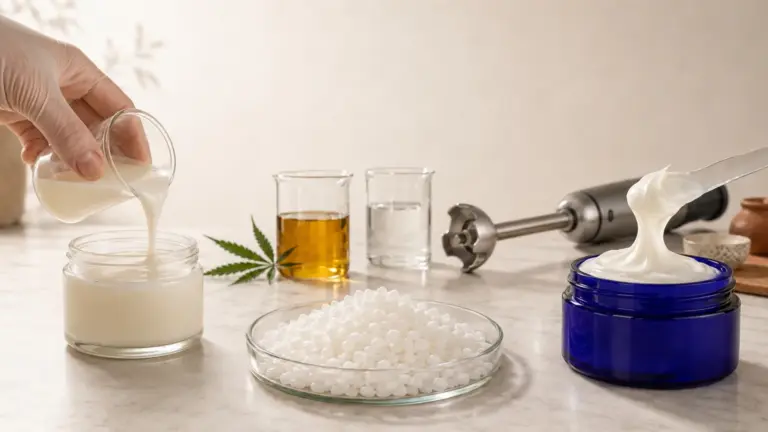
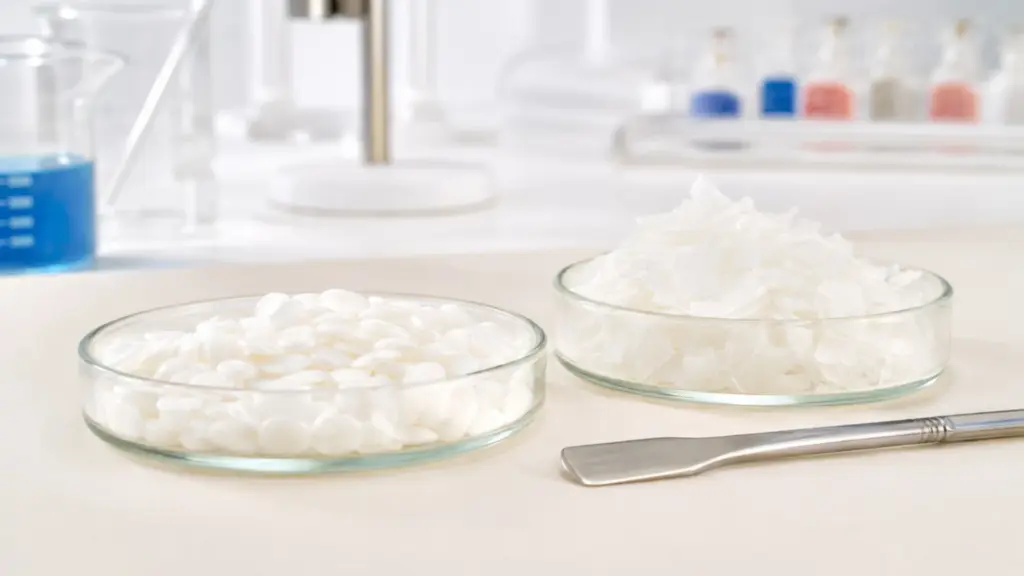
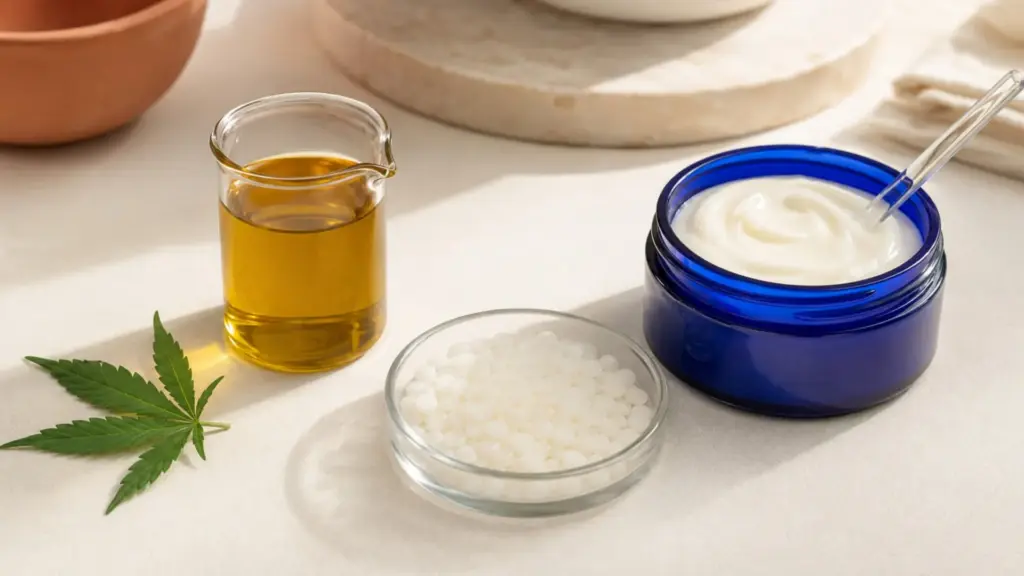
Most home formulators buy Cetearyl Alcohol as white pellets, pastilles or flakes. It is insoluble in water and melts into the heated oil phase. The grade I typically use contains 25% to 35% cetyl alcohol and 65% to 75% stearyl alcohol. That is commonly described as 30:70 Cetearyl Alcohol. However, that ratio is not universal. You can also buy 50:50 and other blends, which is why the supplier and ratio need to be checked before following somebody else’s formulation.
The greater proportion of stearyl alcohol in a 30:70 blend generally pushes the finished product towards a creamier, firmer and more cushioned feel. A blend with more cetyl alcohol may feel lighter and more slippery. That does not make one grade better than another. It means they should not be swapped blindly when the texture matters.
Why Use Cetearyl Alcohol in Skincare?
These benefits come from the way Cetearyl Alcohol changes both the structure of a formulation and the way it feels during application.
It Builds Viscosity and Structure
Within an emulsion, it increases viscosity and helps build structure as the product cools. This is particularly useful when the primary emulsifier produces a lotion that is stable but thinner than the product you want.
It is not simply a matter of turning a liquid into a solid. A well-judged amount can give a lotion enough body for a pump bottle, make a cream sit properly in a jar or stop an anhydrous balm becoming too soft in warm weather.
It Supports Emulsion Stability
In a compatible oil-in-water emulsion, it can support stability by helping the continuous phase develop more structure. It only works within a suitable emulsifying system and cannot compensate for the wrong emulsifier, poor mixing or an unsuitable oil phase.
It Improves Slip and Creaminess
Cetearyl Alcohol gives a cream a more “cushioned” feel under the fingers. It can reduce the loose, wet feeling found in some lotions and replace it with a controlled glide that feels more substantial without feeling greasy.
The finish depends on the percentage used, the ratio of cetyl to stearyl alcohol, the oils and butters, and the primary emulsifier. At a modest level it may simply make the formulation feel smoother. At a higher level it can become distinctly creamy, waxy or firm.
It Acts as an Emollient
Cetearyl Alcohol is an emollient, so it helps the finished product leave the skin feeling softer and smoother. It is not a humectant and does not attract water in the way that glycerin does, but its emollient effect can still contribute to the overall moisturising performance of the formulation.
It Adds Opacity
It can also make a formulation look whiter and more opaque. This is one reason it is found in so many creams, conditioners and cleansing products. The change is cosmetic rather than therapeutic, but appearance matters. A smooth, cohesive cream is far more inviting than a thin emulsion that looks as if it may split at any moment.
Cetearyl Alcohol Is Not a Complete Emulsifier
This is the point worth getting absolutely clear. Cetearyl Alcohol is often found inside emulsifying waxes, but that does not mean the bag of plain Cetearyl Alcohol on your shelf can replace them.
Emulsifying Wax NF commonly lists Cetearyl Alcohol and Polysorbate 60. BTMS-25 lists Behentrimonium Methosulfate and Cetearyl Alcohol. Montanov 68 lists Cetearyl Alcohol and Cetearyl Glucoside. In each case, Cetearyl Alcohol provides a substantial part of the body and structure, while the surfactant component does the essential work of bringing oil and water together.
Supplier language can make this confusing. Some technical sheets call Cetearyl Alcohol a co-emulsifier because it strengthens the system around a primary emulsifier. Cosmetic databases may also include an emulsifying function. In practical home formulation, however, it should be treated as a structuring ingredient and emulsion stabiliser, not as a dependable stand-alone emulsifier.
This distinction also prevents expensive mistakes. If a formulation calls for 5% BTMS-25, replacing it with 5% Cetearyl Alcohol removes the Behentrimonium Methosulfate that emulsifies and conditions. If a formulation calls for Montanov 68, plain Cetearyl Alcohol removes the Cetearyl Glucoside. The pellets may look similar, but the chemistry and the finished product will not be similar at all.
You can read more about the composition and behaviour of Emulsifying Wax BTMS-25 and Montanov 68 emulsifier in their individual formulation guides.
How It Helps Stabilise an Emulsion
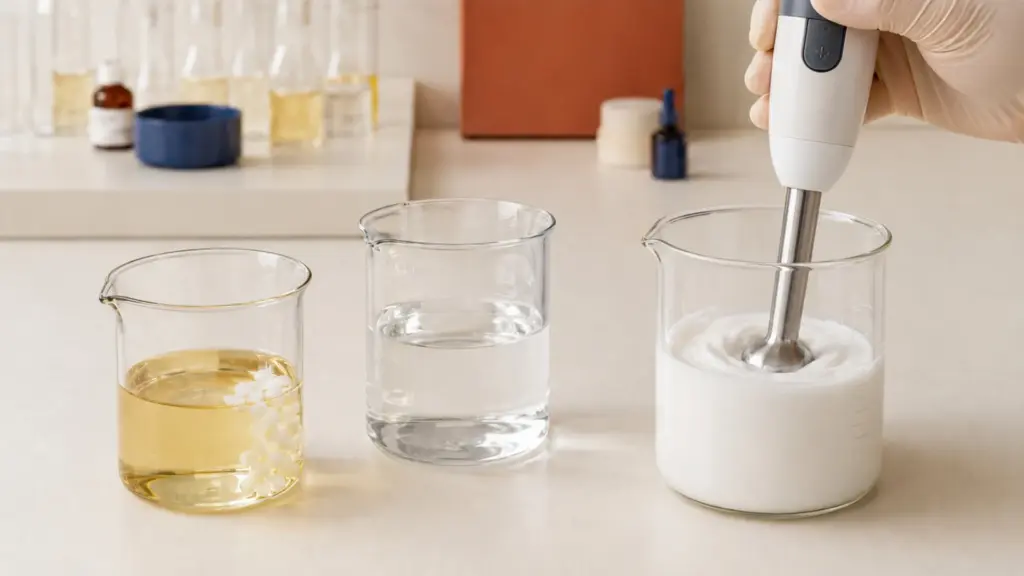
An ordinary description of emulsification says that the emulsifier surrounds tiny droplets of oil and keeps them dispersed through water. That is correct, but Cetearyl Alcohol can help create something more organised than droplets floating independently in a liquid.
As some emulsions cool, fatty alcohol and surfactant molecules arrange themselves into fine layers through the water phase. These are often described as lamellar gel networks. Water is held between the layers, while the network gives the cream body and helps restrict the movement of the oil droplets.
You do not need to see this microscopic structure to notice the result. The emulsion develops viscosity as it cools, becomes more cohesive and may feel creamier on the skin. Research into the stabilising effect of mixed cetyl and stearyl alcohols helps explain why a mixture can behave differently from either fatty alcohol used alone.
Not every formula containing Cetearyl Alcohol forms the same type or amount of lamellar structure. The emulsifier, fatty alcohol ratio, water content, temperature, shear and cooling process all influence the result. It is safer to say that Cetearyl Alcohol can help build these structures in compatible systems than to claim that it automatically creates them in every cream.
The viscosity created by this structure can support physical stability, but it does not prove that the formulation is stable. The finished product still needs appropriate stability testing.
How to Use Cetearyl Alcohol in Formulations
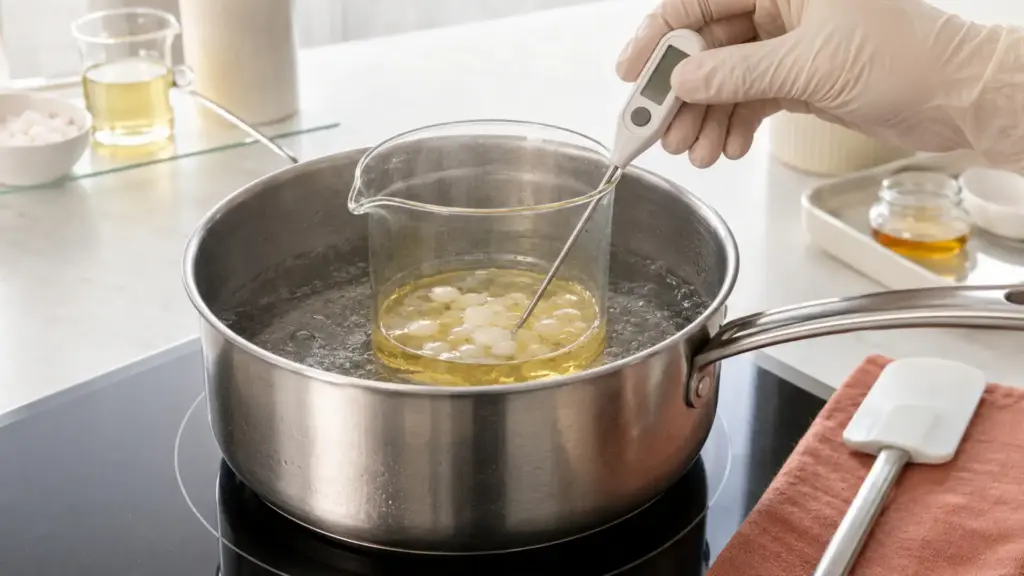
Cetearyl Alcohol is usually added to the heated oil phase. Weigh it with the oils, butters and oil-soluble emulsifier, then heat the phase until every pellet has melted and the mixture is completely uniform.
Typically, Cetearyl Alcohol melts between 49°C and 56°C. That does not mean every emulsion should be combined at 56°C. The primary emulsifier may require both phases to reach 70 to 75°C and remain there long enough to melt and hydrate correctly. Follow the requirements of the complete emulsifying system rather than using the melting point of Cetearyl Alcohol as the only temperature guide.
Do not judge the final viscosity while the emulsion is still warm. Allow it to cool fully and assess it again after at least 24 hours before changing the percentage.
For an anhydrous balm, stick or solid serum, melt Cetearyl Alcohol with the oils and butters. Stir during cooling so the mixture remains even, then pour at the temperature appropriate for the container and the rest of the formula.
Label the storage bag clearly. Cetearyl Alcohol, BTMS-25, Emulsifying Wax NF and several other ingredients can all arrive as remarkably similar white pellets. Discovering the mix-up after the water phase has been added is a miserable way to spend an afternoon.
Usage Rates
There is no single correct percentage for every product. Supplier ranges vary because Cetearyl Alcohol can play a supporting role in a fluid lotion or become a major structuring ingredient in a solid, water-free formulation.
For practical use, around 0.5 to 2% can make a modest adjustment to viscosity, stability and skin feel. Around 2 to 5% creates a more noticeable thickening and creamier texture in many emulsions. Higher levels can be useful in rich creams and anhydrous products, but they require deliberate formulation and testing.
Sourcing, Palm Oil and Ingredient Claims
The INCI name Cetearyl Alcohol does not reveal whether a particular grade was made from palm, coconut, another vegetable feedstock or a synthetic process. It also does not prove that the material is vegan, palm-free, organic, halal or COSMOS approved.
If sourcing matters to your formulation, ask for the current technical data sheet, certificate of analysis and relevant certification. Do not make an ethical, religious or environmental claim based only on the ingredient name.
Can It Be Substituted?
Cetearyl Alcohol cannot be substituted one-for-one with an emulsifying wax because they do different jobs. It also cannot always be replaced with the same percentage of cetyl alcohol, stearyl alcohol or stearic acid without changing firmness, glide, melting behaviour and stability.
Using Cetearyl Alcohol with Cannabis-Infused Oils
Cannabis-infused oil should be treated as part of the complete oil phase. Cetearyl Alcohol is used to adjust the body, firmness and application of the finished formulation around that known oil phase.
In a cream or lotion, Cetearyl Alcohol still needs to work beside the primary emulsifier. It does not bind cannabinoids to water, increase potency or compensate for poorly filtered infused oil. Its job is physical structure and skin feel.
Do not add Cetearyl Alcohol during the cannabis infusion. It can thicken or solidify as the oil cools, making filtration difficult and increasing the amount of infused oil lost in the plant material and filter. Prepare and strain the infused oil first, then add Cetearyl Alcohol during Stage 1, the heated oil phase of the finished formulation.
In a water-free balm or solid serum, it can increase firmness without relying on a large amount of beeswax. The result is often creamier and less tacky than a simple oil and wax balm, although the percentage and supplier grade still matter.
Cetearyl Alcohol is not an antioxidant or preservative. Oxidation of the infused oils and preservation of water-containing formulations must be managed separately.
Where to Use Cetearyl Alcohol
Cetearyl Alcohol is useful in a wide range of emulsions and water-free formulations, including:
- Face and body creams that need more cushion and body.
- Hand creams where staying power matters more than a very dry finish.
- Lotions that need enough viscosity for pump packaging.
- Hair conditioners and masks made with a suitable cationic emulsifier.
- Cleansing creams and balm cleansers where slip and rinse behaviour need balancing.
- Body butter bars, solid serums and deodorant sticks.
- Lipsticks, beard balms and other anhydrous products that need structure.
A pump lotion, jar cream and solid stick need very different structures, so select the amount to suit the intended product and its packaging.
Safety of Cetearyl Alcohol in Skincare
The Cosmetic Ingredient Review safety assessment concluded that Cetearyl Alcohol and the other long-chain fatty alcohols assessed were safe in the practices of use considered. That does not mean an individual reaction is impossible. Use cosmetic-grade material from a reputable supplier, follow its documentation, assess the safety of the complete formulation and patch test a finished product appropriately. Do not rub the raw ingredient onto the skin as a home allergy test.
Cetearyl Alcohol Formulations on 420formulator
The easiest way to understand a structural ingredient is to see what it does in a real formulation.
My Solid Facial Oil with Mango Butter uses plain Cetearyl Alcohol at 24%. That high level is deliberate because this is an anhydrous solid serum, not a cream or lotion. It shows how effectively Cetearyl Alcohol can harden oils while retaining a smooth skin feel.
The Oat Oil and Cannabis Lotion uses BTMS-25, so Cetearyl Alcohol is already present inside the emulsifier blend. This is a useful example of why you should examine the complete INCI before adding another fatty thickener.
The Calendula Hand Cream Recipe uses Montanov 68, which combines Cetearyl Alcohol with Cetearyl Glucoside. The two ingredients work as a complete emulsifying system, with the fatty alcohol contributing structure and skin feel.
My Conditioning Beard Balm uses BTMS-25 in a water-free product. It demonstrates how an emulsifying blend that contains Cetearyl Alcohol can also contribute body, slip and conditioning outside a conventional lotion.
Conclusion
Cetearyl Alcohol earns its place by doing several quiet jobs well. It can turn an unfinished lotion into a cream with proper body and glide, or give a water-free formulation structure without relying entirely on wax.
It still has to be used as part of a properly designed formulation. It is not a preservative, antioxidant or complete emulsifier, and its effect depends on the grade, percentage, emulsifying system and manufacturing process.
Used with those limits in mind, Cetearyl Alcohol is one of the most useful and economical structural ingredients a formulator can keep on the shelf.
🎧 Listen Instead
 Spotify
 YouTube
FAQ
Can Cetearyl Alcohol replace emulsifying wax?
No. It may be described as a co-emulsifier because it supports the surrounding system, but it is not a reliable complete emulsifier by itself. Plain Cetearyl Alcohol mainly contributes structure, viscosity, skin feel and support for stability. A suitable primary emulsifier is still required.
Is Cetearyl Alcohol the same as cetyl alcohol?
No. Cetyl alcohol is an individual C16 fatty alcohol. Cetearyl Alcohol is a mixture made predominantly from cetyl and stearyl alcohols. The mixture usually feels creamier and firmer than cetyl alcohol alone, depending on the ratio.
Is Cetearyl Alcohol drying to the skin?
No. It is a long-chain fatty alcohol and behaves as an emollient and structural ingredient. It is chemically and functionally different from ethanol and the volatile alcohols associated with a drying skin feel.
What percentage of Cetearyl Alcohol should I use?
Around 0.5 to 5% covers many emulsion applications, while higher amounts may be used deliberately in rich or anhydrous products. Always follow the supplier specification and test the complete formulation because emulsifier blends may already contain a substantial amount.
Which phase should Cetearyl Alcohol be added to?
It is normally added to the heated oil phase and melted completely before the oil and water phases are combined. Follow the processing temperature required by the primary emulsifier.
Can I use Cetearyl Alcohol in a balm or solid serum?
Yes. It can thicken and harden water-free formulations while giving a creamy, slippy finish. The percentage may be much higher than in a lotion, so test firmness, pay-off and heat stability carefully.
Is Cetearyl Alcohol safe for sensitive skin?
It is generally well tolerated and has been assessed as safe in established cosmetic uses, but uncommon contact allergy has been documented. Anyone with persistent dermatitis or known cosmetic allergies should discuss reactions with a qualified clinician.
Is Cetearyl Alcohol natural and palm-free?
Not necessarily. It may be made from palm, coconut, other vegetable sources or synthetic feedstocks. The INCI name alone cannot confirm the source, so check the supplier documentation.
Does Cetearyl Alcohol preserve a cream?
No. It contributes physical structure but does not provide broad-spectrum microbial preservation. Any formulation containing water needs an appropriate preservative system.
If you liked this blog post, I would love it if you shared it with a friend.
If you use Pinterest, please pin this post.