
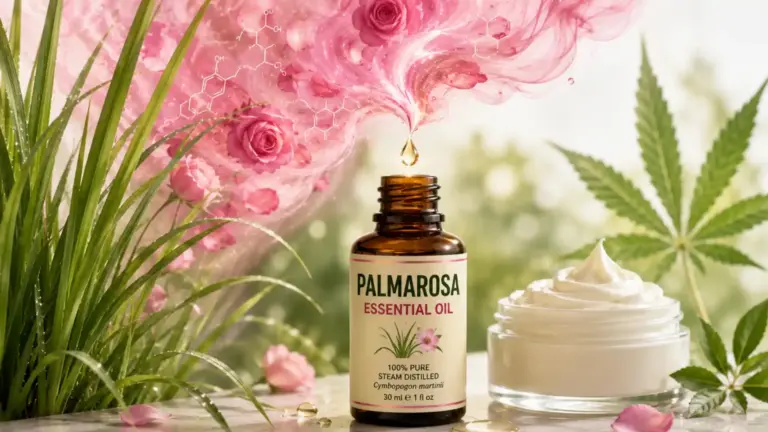
Palmarosa essential oil benefits go far beyond its soft, rosy aroma. This is an oil I use for a reason, especially in skincare formulations where dry, oily, mature, blemish-prone or uncomfortable skin needs gentle support without a heavy fragrance.
Whether you’re new to aromatherapy or already formulate your own skincare products, understanding Palmarosa properly is about more than its pleasant floral aroma. It’s the chemistry behind the oil, and how you use it, that reveals its true value.
If you are new to the relationship between essential oils and other botanical ingredients, my guide to aromatherapy and skincare explains how the different materials fit together.
Table of Contents
As an Amazon Associate, I earn from qualifying purchases.
Botanical Name and INCI
One of the first things that surprises people about Palmarosa is that it comes from a grass rather than a flower. Despite that, the essential oil has a beautifully soft, rose-like aroma that has earned it a place in skincare, perfumery and aromatherapy for many years.
Its botanical name is Cymbopogon martinii var. motia, while the INCI name you’ll see on cosmetic ingredient labels is Cymbopogon Martini Oil. It is worth becoming familiar with both names because cosmetic suppliers usually list the INCI name, whereas essential oil suppliers often use the botanical name.
According to the European CosIng database, Palmarosa is recognised as a fragrance, skin conditioning and tonic ingredient. Fragrance simply refers to the aroma it contributes to a product. Skin conditioning means it helps leave the skin feeling softer and in better condition, while tonic refers to ingredients that help maintain the skin in good condition and support its overall appearance. These are recognised cosmetic functions rather than therapeutic claims.
History of Palmarosa Essential Oil
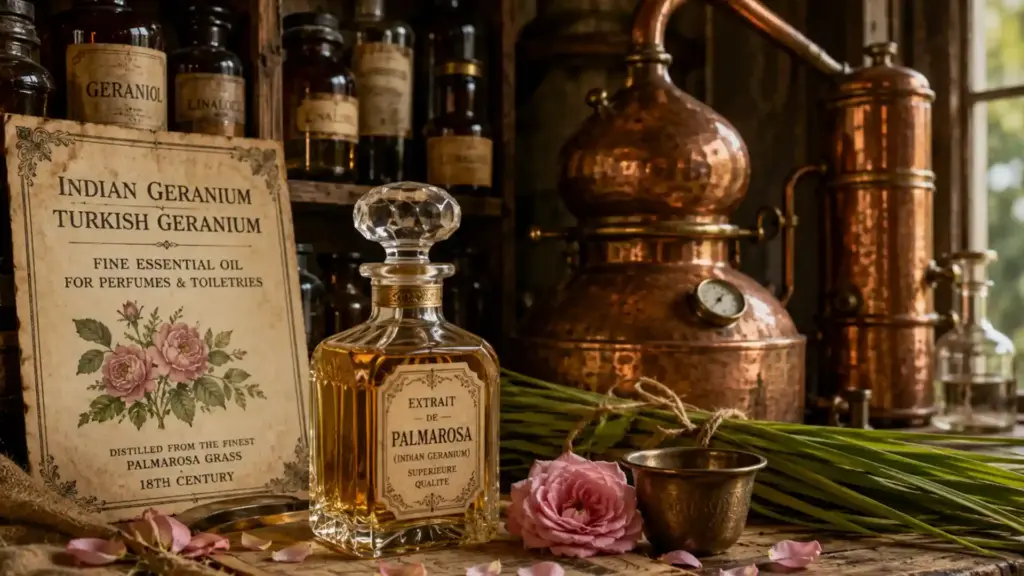
One of the most interesting things about Palmarosa is that, for many years, people didn’t always recognise it as Palmarosa at all. Thanks to its naturally high geraniol content, one of the key terpenes found in many essential oils and some cannabis cultivars, it was traded under names such as Indian Geranium and Turkish Geranium, long before essential oil chemistry could explain why its aroma resembled that of rose so closely.
Native to India, Palmarosa has been cultivated and distilled for centuries, with commercial distillation beginning during the eighteenth century. As its reputation spread beyond Asia, it became an important ingredient in soaps, perfumes and cosmetics, where its soft floral aroma and reliable quality made it well suited to a wide range of products.
Its rosy character also led to a more dubious role. Because Palmarosa was far less expensive than true rose oil, it was sometimes blended with or used to extend expensive rose oil before it reached the market. Although this would now be regarded as adulteration, it also showed just how convincingly Palmarosa could imitate the aroma of true rose oil.
Nowadays, Palmarosa is recognised for far more than its resemblance to rose. Aromatherapists and formulators appreciate it for its versatility and how well it blends with other essential oils. It no longer needs to be known as “the oil that smells like rose”. It is valued simply for being Palmarosa.
Origins, Cultivation and Quality
Where an essential oil is grown can have a surprising effect on its aroma, chemistry and quality. With Palmarosa, climate, harvest timing and careful distillation have a much greater influence than country of origin alone.
Native to India, Palmarosa is now cultivated in several tropical and subtropical regions, including Nepal, Madagascar, Brazil and parts of Africa. Although the plant adapts well to different environments, warm temperatures, good rainfall and well drained soils generally produce the healthiest crops.
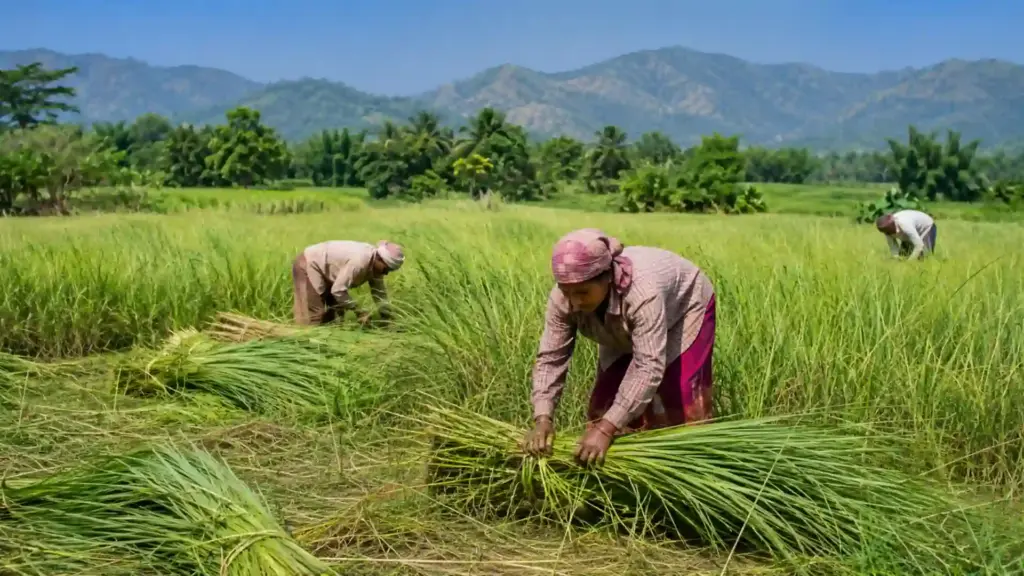
Unlike Lavender, where altitude plays a major role in determining ester content, the quality of Palmarosa depends more on harvesting the grass at the correct stage of growth and distilling it soon after cutting. Waiting too long or using poor quality plant material can reduce both the yield and the quality of the finished oil.
As with any essential oil, the country of origin is only part of the story. Good cultivation, careful harvesting and skilled distillation are far more important than the name on the label. A well produced Palmarosa from one region will always outperform a poorly produced oil from another.
Extraction Method
How an essential oil is distilled has a direct effect on its aroma, chemical profile and ultimately how it performs in a formulation. Even well-grown Palmarosa can produce an inferior oil if the distillation process is rushed or poorly controlled.
Palmarosa essential oil is obtained by steam distillation of the fresh or slightly dried aerial parts of the plant, particularly the leaves and flowering tops. The harvested material is packed into a still and steam is passed through it, releasing the volatile compounds. As the vapour cools, it naturally separates into essential oil and hydrosol.
The finished oil is usually pale yellow to almost colourless and is classified as a middle note in perfumery. Its aroma is soft, rosy, slightly sweet and gently herbaceous, making it easy to blend with floral, citrus, woody and herbaceous essential oils.
Chemical Profile of Palmarosa Essential Oil
You don’t need to understand every constituent in Palmarosa to use it successfully, but knowing a few of the main ones helps explain why it has become such a useful essential oil in skincare formulations. Like every essential oil, Palmarosa contains dozens of constituents that work together. Some influence its fragrance, others contribute to its performance in skincare formulations, and together they give the oil its distinctive character.
Geraniol
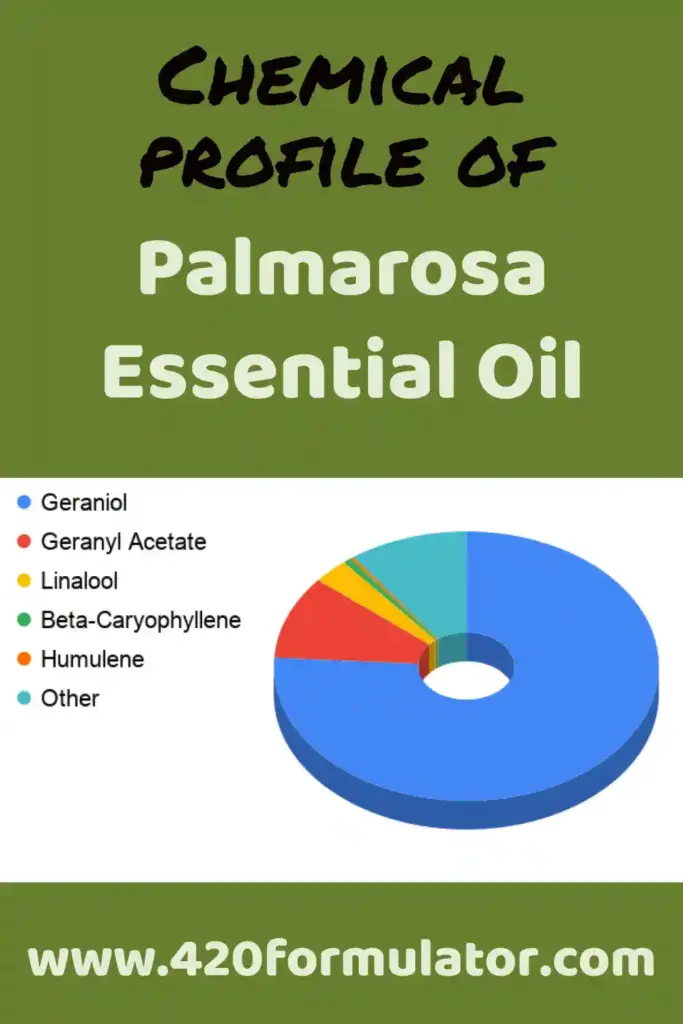
Geraniol is by far the dominant constituent of Palmarosa, typically making up 70% to 85% of the essential oil. It is a monoterpene alcohol responsible for the oil’s unmistakable rosy aroma and one of the reasons Palmarosa was once used to adulterate expensive rose oil.
For formulators, the high Geraniol content is one of the reasons Palmarosa is such a popular choice for products designed for dry, mature and blemish-prone skin. It also makes the oil exceptionally easy to blend with many other floral and citrus essential oils.
Geranyl Acetate
Geranyl Acetate is the principal ester in Palmarosa. Although present in much lower amounts than Geraniol, it helps soften the fragrance and gives the oil its smooth, rounded floral character.
It is one of the reasons Palmarosa blends so effortlessly with oils such as Lavender, Geranium, Bergamot and Frankincense.
Linalool
Linalool is present in smaller amounts, usually around 2% to 4%, but still makes an important contribution to the finished oil. It adds a fresh floral note and is another constituent shared with Lavender and many other essential oils. It’s another reminder that essential oils and cannabis often share the same chemistry.
Other Important Constituents
Palmarosa also contains smaller amounts of Citronellol, Nerol, Farnesol, Beta-Caryophyllene, Humulene and Elemol. Although present in much smaller amounts than Geraniol, they all contribute to the finished oil.
Beta-Caryophyllene and Humulene are also found in cannabis, although usually in much higher amounts. They’re another good example of why I often say that cannabis and essential oils have far more in common than many people realise.
Looking at one constituent on its own never tells the whole story. It’s the balance between all of these constituents that gives Palmarosa its unique character.
Benefits and Therapeutic Uses of Palmarosa Essential Oil
Understanding the chemistry of Palmarosa is useful, but what really matters is how that chemistry translates into everyday formulations. One of the reasons I enjoy working with Palmarosa is its versatility. It isn’t an essential oil that only suits one skin type or one particular formulation. Whether you’re making a facial serum, body cream, massage oil or shampoo, Palmarosa seems to find its place without dominating the blend.
Skin Care
Palmarosa is one of the few essential oils that works well across a wide range of skincare products. It helps improve hydration while balancing sebum production, making it equally useful in formulations for dry, mature and oily skin. That’s not something you find very often in a single essential oil.
I never use Palmarosa simply because it smells nice. If it’s in one of my formulations, I want it to be there because it is contributing something useful to the finished product. Whether that’s a facial serum, moisturiser, body lotion or massage oil, Palmarosa is there for its skin conditioning and emollient properties.
- Helps improve hydration while balancing excess sebum, making it suitable for both dry and oily skin. Have a look at this Mango Shea Body Butter formulation.
- A useful addition to facial serums, moisturisers and lotions for mature, dehydrated and combination skin.
- Often included in formulations for blemish-prone skin and to help improve the appearance of old acne scars.
- A good choice for dry, rough and irritated skin because of its excellent skin conditioning and emollient properties. It also works well in formulations for dry skin associated with conditions such as eczema and dermatitis.
- A great choice for foot creams where antifungal properties are important. Tea Tree usually gets all the attention, but Palmarosa can do a similar job while giving your formulation a much more elegant fragrance. There’s no rule that every foot cream has to smell like a medicine cabinet.
- Palmarosa sits comfortably in cannabis-infused creams, lotions and balms because it brings more than fragrance. Its skin conditioning and emollient properties give it a genuine reason to be included.
Hair Care
Palmarosa is best thought of as a scalp care oil rather than a glamorous hair treatment oil. The scalp is skin, so the same qualities that make Palmarosa useful for dry, oily or irritated skin can also make it useful in shampoos, conditioners, scalp oils and hair masks.
I would not present Palmarosa as a miracle oil for hair growth. That is not where its real value sits. I would use it where the scalp needs support, especially if it feels dry, irritated, itchy, flaky or out of balance.
- A useful addition to shampoos for scalps prone to dryness, irritation or flaking.
- Helpful in scalp oils and pre-shampoo treatments where the oil has more contact time than it would in a rinse-off shampoo.
- Worth considering in blends for flaky or dandruff-prone scalps, especially where irritation and scalp freshness are part of the concern.
- Useful for oily scalps because it helps balance sebum without giving the formula a harsh or medicinal character.
- Blends well with Helichrysum in conditioners and hair packs for irritated scalps.
- Works best in gentle formulations. If the shampoo base is harsh and stripping, adding a few drops of essential oil will not fix the formula.
Other Uses
Although I use Palmarosa mainly in skincare, it also has an important place in aromatherapy. Its soft, rosy aroma has a calming quality, but it does not feel heavy, sleepy or overpowering. That makes it useful when you want a blend to feel steady, clear and emotionally supportive.
- A good choice in blends for emotional fatigue, insecurity or muddled thinking, where the aim is to feel calmer, clearer and more emotionally steady rather than sedated.
- Useful in diffuser blends when you want to create a calm, balanced atmosphere without the richness of heavier floral oils.
- Works well in massage oils because it brings both skin conditioning benefits and a gentle emotional softness.
- Particularly useful when a blend needs to feel comforting without becoming sleepy or sentimental.
- Combines well with Lavender, Frankincense, Bergamot, Green Mandarin, Geranium and Cedarwood when you want a calm but still clear aromatic profile.
Palmarosa vs Rose Geranium: Which Should You Choose?
Palmarosa and Rose Geranium are often grouped together because they both have a rosy, floral character. That does not make them interchangeable.
Palmarosa comes from a grass, Cymbopogon martinii. Rose Geranium comes from Pelargonium graveolens or closely related Pelargonium species. That botanical difference matters because the oils do not smell, behave or formulate in exactly the same way.
Palmarosa is led by Geraniol, which gives it that soft rosy note. The aroma is fresh, gentle and slightly grassy, with a floral sweetness that does not usually dominate a blend. Rose Geranium has a fuller geranium character, often greener, leafier, richer and more assertive.
In skincare, I would choose Palmarosa when I want the oil to feel light, clean and quietly floral. It works well in facial serums, creams, lotions, foot products and scalp care where the skin function matters as much as the aroma.
I would choose Rose Geranium when I want a stronger floral heart note and a more obvious geranium character. It can be beautiful, but it has more personality and can take control of a blend if you use too much.
Palmarosa should not be treated as a cheap substitute for Rose or Rose Geranium. That was part of its history, but it is not how I would use it now. It has its own chemistry, its own skincare value and its own place in formulation. Use Palmarosa when you want Palmarosa.
Using Palmarosa with Cannabis-Infused Formulations
In my experience, cannabis-infused oils rarely smell strongly of cannabis once they are used in a finished cream, lotion, balm or massage oil. The finished aroma usually comes more from the carrier oils, butters, waxes and essential oils in the formulation.
That is why I would not add Palmarosa to “cover” the smell of cannabis. If Palmarosa goes into a cannabis-infused product, it should be there for a specific function.
In skincare formulations, Palmarosa makes sense when you want an essential oil that offers more than fragrance. Its skin conditioning, emollient and sebum-balancing qualities make it useful in facial creams, body lotions, balms, foot creams, massage oils and scalp care products.
There is also a useful terpene connection. Palmarosa is dominated by Geraniol, with smaller amounts of constituents such as Linalool, Citronellol, Farnesol, Beta-Caryophyllene and Humulene. Some of these constituents are also found in cannabis, which is why essential oils and cannabis often overlap chemically, even though they come from very different plants.
Some cannabis cultivars may contain overlapping terpenes such as Linalool, Beta-Caryophyllene, Humulene or small amounts of Geraniol, but the only reliable way to compare them is by looking at a current terpene analysis, not by relying on strain names.
That does not mean Palmarosa and cannabis do the same thing. Shared terpenes are not a magic shortcut. They simply give us a way to think more intelligently about aroma, ingredient choice and formulation design.
For me, the practical value is simple. Palmarosa can bring a soft floral character to cannabis-infused skincare while also doing useful work for the skin. That is the reason to include it. Not because it smells pretty, and not because it sounds good on a label.
Topical Use and Formulations
Palmarosa is a useful oil, but it still needs a job. I would choose it for dry, oily, mature, blemish-prone, rough or uncomfortable skin, not simply because it has a pleasant rosy aroma.
For leave-on facial products, 0.25% to 0.5% is usually enough. In body creams, balms, massage oils, foot products and scalp treatments, 0.5% to 1% is a sensible working range. If you are using other essential oils in the same formula, keep the total essential oil percentage in mind.
Palmarosa is oil soluble. In creams and lotions, I would add it during cool-down, once the emulsion has dropped below 40°C, rather than heating it with the main oil phase.
It works well in:
- Facial serums and moisturisers for dry, mature or combination skin.
- Body creams and lotions where skin conditioning matters more than strong fragrance.
- Foot creams where antifungal support is useful.
- Scalp oils, conditioners and hair masks for dry or irritated scalps.
- Cannabis-infused creams, lotions and butters where every ingredient needs a clear purpose.
- Massage oils where you want both skin conditioning and a gentle, calming aroma.
Use enough Palmarosa to support the formulation, not so much that it takes over. A few drops can improve a good product, but no essential oil will rescue a harsh shampoo, greasy balm or unstable cream. Get the formulation right first.
Blending Suggestions
Palmarosa blends easily, but it still needs restraint. Its rosy sweetness can become too obvious if you use too much, especially in leave-on facial products. I usually treat it as a soft floral heart note with a skincare function, not as the whole fragrance.
The blends below each total 20 drops, which is suitable for adding to 99 g of product to give an approximate 1% essential oil dilution. Add the blend to your chosen carrier oil, balm, cream, lotion or massage product, and always keep the total essential oil percentage in mind.
Skin Balance
A soft, practical blend for facial oils, creams and lotions where the aim is skin conditioning without a heavy floral aroma.
- Palmarosa: 6 drops
- Lavender: 5 drops
- Frankincense: 4 drops
- Green Mandarin: 3 drops
- Cedarwood Atlas: 2 drops
Total: 20 drops
Soft Foot Cream
A cleaner, more elegant alternative to the usual harsh-smelling foot blend.
- Palmarosa: 6 drops
- Tea Tree: 5 drops
- Lavender: 4 drops
- Cedarwood Atlas: 3 drops
- Patchouli: 2 drops
Total: 20 drops
Calm but Clear
For diffuser blends, massage oils or body products where you want something calming but not sleepy.
- Palmarosa: 5 drops
- Frankincense: 5 drops
- Green Mandarin: 4 drops
- Lavender: 4 drops
- Black Spruce: 2 drops
Total: 20 drops
Scalp Comfort
A useful blend for scalp oils, conditioners and hair masks where the scalp feels dry, uncomfortable or out of balance.
- Palmarosa: 5 drops
- Helichrysum: 4 drops
- Lavender: 4 drops
- Cedarwood Atlas: 4 drops
- Rosemary: 3 drops
Total: 20 drops
Rose Without Rose
A gentle floral blend for body creams, massage oils or natural perfumery when you want a soft rosy character without using Rose Otto.
- Palmarosa: 7 drops
- Geranium: 4 drops
- Frankincense: 4 drops
- Bergamot FCF: 3 drops
- Sandalwood: 2 drops
Total: 20 drops
For leave-on facial products, keep the final dilution low. For body products and massage oils, you can usually work a little higher, but the total essential oil percentage still matters more than the number of drops in the blend.
Contraindications and Safety
Palmarosa is generally well tolerated, but it is still an essential oil and should not be used neat on the skin.
For facial products, use around 0.25% to 0.5%. For body products, massage oils, balms, foot creams and scalp treatments, 0.5% to 1% is usually enough.
Avoid use around the eyes, mucous membranes or broken skin. Patch test if you have sensitive skin or fragrance allergies.
Use low dilutions during pregnancy, breastfeeding, illness or when taking medication. Do not use routinely on babies, and use caution around pets.
Palmarosa is not known to be phototoxic.
Chakra Associations
Chakras are part of the traditional energetic model used in yoga, meditation and many forms of bodywork. I do not treat them as medical anatomy, but they can be a useful way to think about the emotional character of an essential oil.
Palmarosa has its strongest connection with the Heart Chakra. Its soft rosy aroma, emotional gentleness and ability to support a calmer, more balanced mood make it especially suited to blends for emotional recovery, self-acceptance and gentle reconnection.
4th Chakra (Heart Chakra / Anahata)
The heart chakra connects you with love, compassion, and kindness. It’s the bridge between the lower and upper chakras, helping you form deeper connections with others and with yourself. A balanced heart chakra brings harmony and forgiveness.
Location: Center of chest
Qualities: Love, compassion, forgiveness, connection
Mantra: “I am open to love and compassion”
Colour: Green (sometimes pink)
Element: Air
Stone: Rose Quartz, Green Aventurine, Jade
Palmarosa essential oil is a good choice when a blend needs to feel emotionally soft, steady and open-hearted without becoming heavy or overly sentimental. It is especially useful where the intention is comfort, emotional balance and gentle self-kindness.
Chinese Emotions of the Organs
In Traditional Chinese Medicine (TCM), each main emotion is linked to a specific organ, so how you feel affects your body and vice versa. Keeping your emotions balanced helps keep your organs healthy, and looking after your organs supports your emotional wellbeing.
Palmarosa is not an oil I associate with forceful emotional clearing. It is better suited to emotional tiredness, muddled thinking, insecurity, self-kindness and the need to feel steady again.
Heart and Colon
Heart and Colon – joy, love, constipation. Lack of self-love and letting go.
Palmarosa’s soft rosy aroma makes this the most obvious emotional link. It has a gentle, heart-softening quality without the intensity or cost of Rose. I would use it in blends where the emotional focus is comfort, self-kindness and learning to let go without forcing the process.
This is also where Palmarosa can be useful for people who feel emotionally closed down or disconnected from themselves. It does not push. It reassures.
Stomach
Stomach – assimilation. How you take on events and situations.
The stomach connection makes sense when you think about Palmarosa’s traditional use for nervous tension and muddled thinking. Some people do not just “think” about stressful situations, they take them in physically and emotionally.
Palmarosa suits blends where the aim is to settle, soften and process what has happened. It is not a sharp mental stimulant. It helps the blend feel calmer and easier to receive.
Spleen
Spleen – sympathy, overly sympathetic or callous.
The Spleen association fits Palmarosa when emotional tiredness, over-giving or mental fatigue are part of the picture. This is the person who has been running on empty, caring too much, thinking too much, or feeling drained by other people’s needs.
Palmarosa brings a soft steadiness to this kind of blend. It is not a dramatic oil, but that is part of its value. It gives support without adding more emotional noise.
Conclusion
Palmarosa is one of those essential oils that can be easy to underestimate. Because it smells soft, rosy and pleasant, it is tempting to think of it mainly as a fragrance oil. That would miss the point.
Its real value is in the way it supports formulation. The high Geraniol content helps explain why Palmarosa is so useful in products for dry, oily, mature, blemish-prone or uncomfortable skin. It also has a place in foot creams, scalp care, massage oils and cannabis-infused formulations where every ingredient needs a clear purpose.
I would not use Palmarosa as a cheap substitute for Rose or Rose Geranium. It deserves better than that. Use it when you want an essential oil that brings skin conditioning value, a soft floral heart note and a calm emotional quality without dominating the whole blend.
Palmarosa may be gentle, but it is not boring. Used well, it is practical, elegant and quietly effective.
🎧 Listen Instead
 Spotify
 YouTube
FAQ
What is Palmarosa essential oil good for?
Palmarosa essential oil is mainly used in skincare, aromatherapy and natural perfumery. In formulations, I value it most for dry, oily, mature, blemish-prone or uncomfortable skin. Its soft rosy aroma is a bonus, but that is not the main reason I would use it.
Is Palmarosa essential oil good for skin?
Yes, Palmarosa is a very useful skincare oil when properly diluted. It is especially helpful in creams, lotions, balms and facial oils where you want skin conditioning, sebum balance and a softer feel without a heavy floral fragrance. Research also supports Palmarosa’s antimicrobial and anti-inflammatory activity, although that does not mean it should be used as a medical treatment.
Can Palmarosa essential oil be used on oily skin?
Yes. Palmarosa is one of the oils I would consider for oily or combination skin because it can help balance sebum without making the product feel harsh or stripping. It is also useful where the skin is oily but still dehydrated, which is more common than people think.
Is Palmarosa essential oil safe for the face?
Palmarosa can be used in facial products, but only at sensible dilutions. I would usually keep it around 0.25% to 0.5% in leave-on facial products. Do not use it neat, and patch test first if your skin is sensitive or reactive.
Is Palmarosa good for hair?
Palmarosa is better thought of as a scalp care oil than a dramatic hair treatment oil. I would use it in shampoos, scalp oils, conditioners or hair masks where the scalp feels dry, itchy, flaky or out of balance. I would not present it as a miracle hair growth oil.
What does Palmarosa essential oil blend well with?
Palmarosa blends well with Lavender, Frankincense, Green Mandarin, Bergamot, Geranium, Cedarwood, Sandalwood, Patchouli and Helichrysum. It is useful when you want a soft floral heart note that does not take over the whole blend.
Is Palmarosa the same as Rose Geranium?
No. Palmarosa comes from a grass, while Rose Geranium comes from a Pelargonium plant. They can both have a rosy floral character, but they are different oils with different chemistry, aroma and formulation uses. Palmarosa is not a cheap substitute for Rose or Rose Geranium. Use it because you want Palmarosa.
If you liked this blog post, I would love it if you shared it with a friend.
If you use Pinterest, please pin this post.