
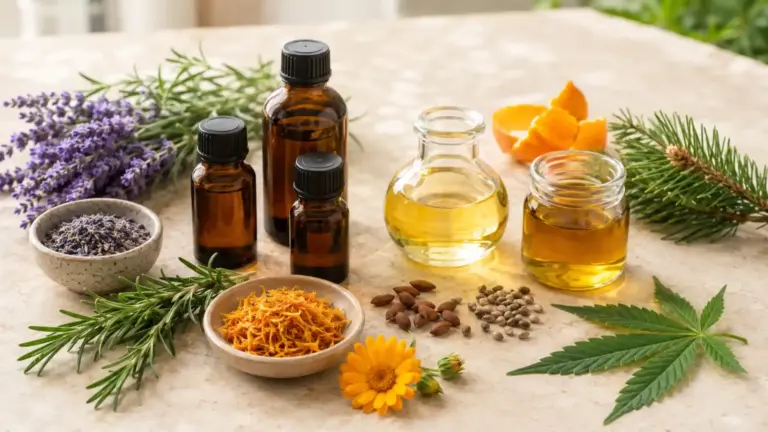
The Aromatherapy section of 420formulator covers essential oils, herbs, vegetable oils and terpenes. They are closely connected, but they are not the same thing, and each has a different place in blending and skincare.
This aromatherapy guide gives you an overview of all four areas. Each section explains what it covers and directs you to the detailed guides and formulations when you want to learn more.
Table of Contents
What Aromatherapy Means
Aromatherapy uses essential oils from plants, most often by breathing in their aroma or applying them to the skin in a diluted product. The National Center for Complementary and Integrative Health describes it as a complementary health approach. That is a useful distinction: aromatherapy can support wellbeing, but it is not a replacement for medical care.
Essential Oils in Aromatherapy
Essential oils are concentrated aromatic extracts taken from flowers, leaves, peel, wood, roots, grasses and resins. Most are steam distilled. Citrus oils such as sweet orange and lemon are usually pressed from the peel. The plant part and extraction method both affect what ends up in the bottle.
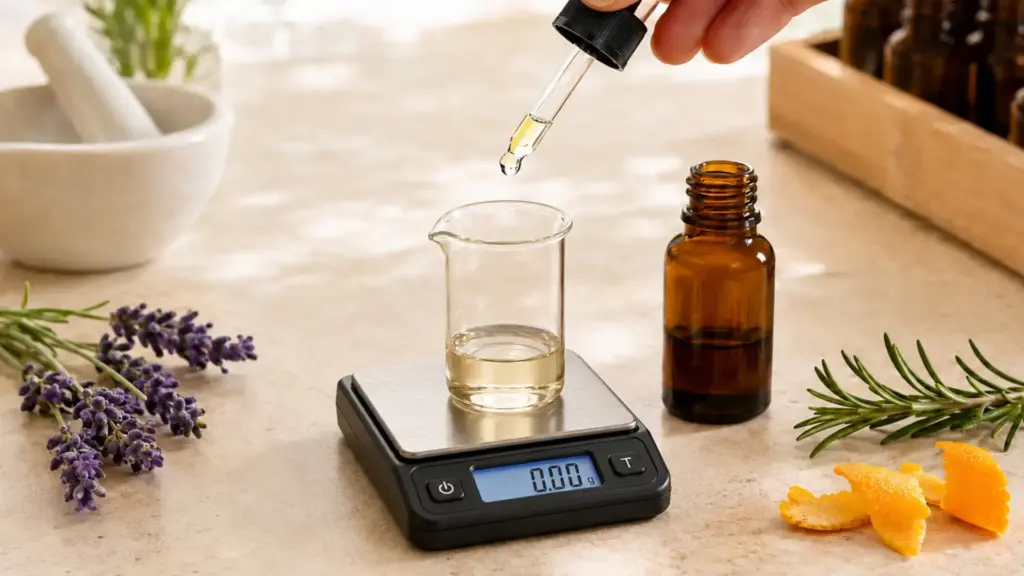
The name on the front of the bottle does not always tell you enough. True lavender, spike lavender and lavandin are different oils, with different compositions and uses. I always check the botanical name, plant part and extraction method before adding an oil to a blend.
When I choose an essential oil, I am not choosing the aroma alone. I consider what I am making, where it will be used and the amount that suits that particular oil. A facial cream, body oil and diffuser blend need different decisions.
My Lavender Essential Oil guide shows why the species, growing conditions and distillation matter, even with a familiar oil. You can also browse the growing Essential Oils collection.
Herbs Alongside Aromatherapy
Using a herb is not the same as using its essential oil. Dried lavender, lavender-infused oil and lavender essential oil all begin with the same plant, but they are different ingredients and cannot be swapped measure for measure.
Herbs can be prepared in water, vegetable oil, glycerine or alcohol. Each method collects a different range of plant compounds, so I choose the preparation to suit the product. An infused oil works well in a balm or the oil phase of a cream, while a water or glycerine extract may suit a properly preserved toner, gel or lotion.
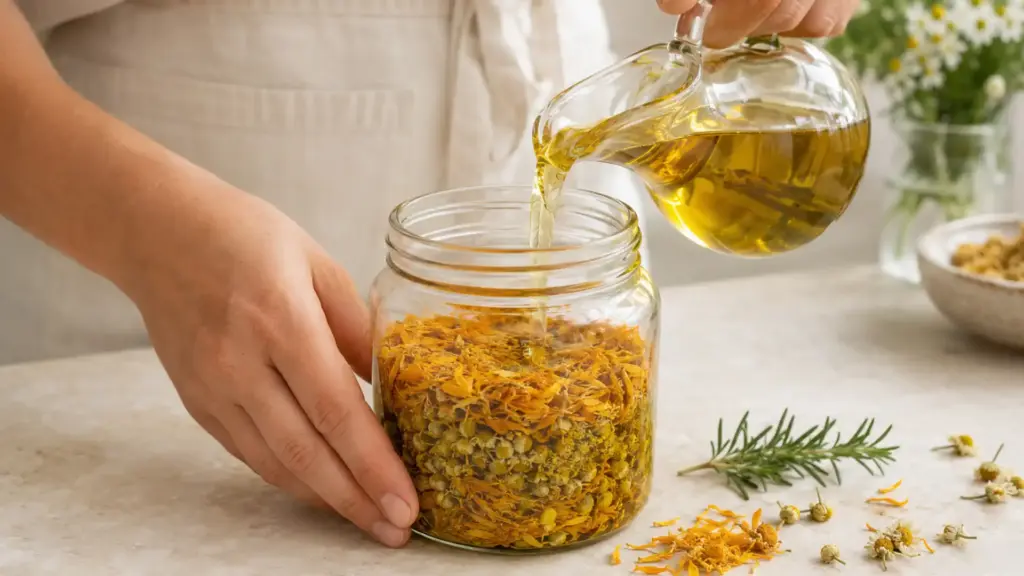
Calendula, chamomile, rosemary and Lady’s Mantle are all useful in skincare. Cannabis is also a herb, but it brings cannabinoids, strength and legal considerations into the picture, so I cover it separately in my DIY cannabis products guide.
My guide to Making Herb-Infused Oil with the POT by NOIDS shows one practical way to transfer useful plant compounds into a vegetable oil. You can also browse the Herbs collection.
Vegetable Oils in Aromatherapy
Vegetable oils are often called carrier oils, which can make them sound like the unimportant part of the blend. They are not. They give us a practical way to dilute essential oils for use on the skin, while also affecting how easily a product spreads, how rich or light it feels and how quickly it oxidises.
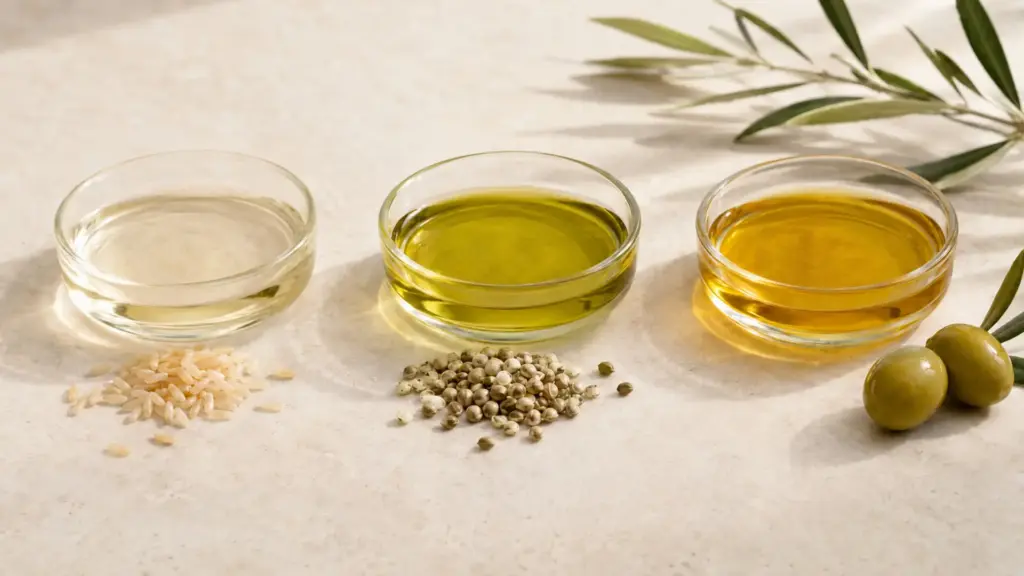
I choose a vegetable oil by looking at its skin feel, fatty acid profile, natural scent, heat tolerance and stability. A light facial oil, a massage blend that needs plenty of glide and an oil that will be heated for an infusion all ask for different choices. Rice bran, hemp seed, meadowfoam and olive oil each behave differently; there is no best carrier oil for every formula. If you want to see those choices working together, my cannabis massage oil recipe uses Meadowfoam, Rice Bran and Marula oils with Lavender, Rosemary and Geranium.
You can explore the individual oils in my Vegetable Oils collection.
Terpenes in Aromatherapy
Terpenes are part of the reason orange peel, pine needles, lavender and cannabis have such distinctive aromas. The same terpene can appear in several unrelated plants, which is where the connection between cannabis and aromatherapy becomes particularly interesting.
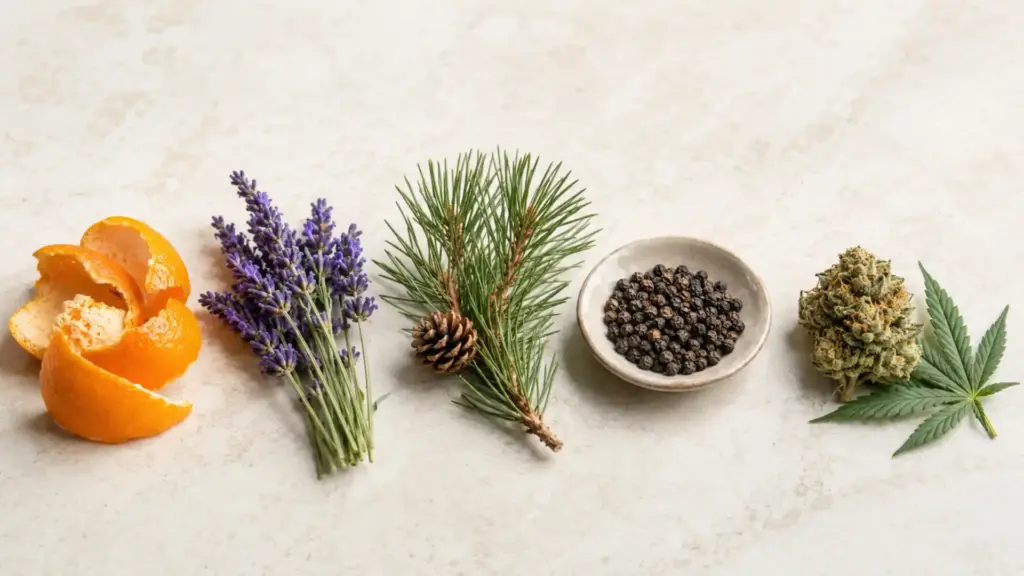
An essential oil contains terpenes and other aromatic compounds in its own natural balance. It is not simply a bottle of terpenes, and an isolated terpene cannot be substituted for an essential oil measure for measure. It is a concentrated ingredient with its own usage and safety information.
Terpenes are more than fragrance molecules. They also contribute to the way an essential oil or cannabis extract behaves, which is why I look at the complete profile rather than choosing one terpene and expecting it to do everything. If pain is your main concern, my guide to the best terpenes for pain and inflammation compares Myrcene, Caryophyllene, Limonene and Linalool across cannabis and essential oils.
With cannabis, the terpene profile can tell us more than the strain name alone. Growing conditions, harvesting, drying, storage and extraction can all change what is present in the final material.
My Cannabis Terpenes for Skin guide explains how this chemistry matters in creams, balms and topical oils. You can also browse the complete Terpenes collection.
For a broader reference to individual compounds, see my guide to the 14 top terpenes in cannabis and essential oils.
How Aromatherapy Ingredients Work Together
The product comes first. Once I know what I am making, I can decide which ingredients have a job to do. There is no reason to force essential oils, herbs, vegetable oils and isolated terpenes into every formula.
- A body oil may need only a vegetable oil and a suitably diluted essential oil blend. If the oil has been infused with calendula or cannabis, the herb is already included.
- A balm uses vegetable or infused oils with butter or wax to create the texture. Essential oils are optional.
- A cream or lotion may contain the same oils, but the addition of water means it also needs an emulsifier and preservative.
Terpenes run through these examples rather than sitting in a separate part of the formula. They are already present in essential oils and may also be present in cannabis extracts. Adding isolated terpenes is a separate formulation choice, not something every product needs.
My guide to Cannabis Topicals explains the differences between infused oils, balms, creams and lotions in more detail.
Using Aromatherapy Safely
Essential oils are concentrated, so more is not automatically better. I measure them as a percentage of the finished product rather than relying on drops, which can vary considerably in size. In a 100g product, 1g of essential oil is 1%. If a blend contains several essential oils, it is their combined weight that counts.
The right amount depends on the oil, the product and where it will be used. A facial cream, body oil, rinse-off product and small-area balm do not need the same dilution. Some oils also have their own dermal limits, which take priority over any general dilution chart.
Robert Tisserand’s guide to essential oil dilution gives useful ranges for different products. If you are making cosmetics for sale, you should also check the supplier’s documentation and the relevant IFRA Standards.
Essential oils do not dissolve in water. Adding a few drops directly to a bath, toner or spray can leave undiluted droplets against the skin, so a suitable dispersant or solubiliser is needed. Some expressed citrus oils can make the skin more sensitive to sunlight, while old or poorly stored oils are more likely to cause skin reactions. Keep the bottles tightly closed and away from heat and light.
Conclusion
You do not need a large collection of oils and extracts to begin. Choose one simple blend or product, make a small batch and write down exactly what you used. Give it time before changing anything. Some blends smell quite different after a day or two, and creams often need time to reach their final texture.
Learn a few materials properly before buying more. Knowing how an oil smells in the bottle is useful, but knowing how it behaves in a finished product is what helps you become a better formulator.
When you are ready for your next project, browse the complete Aromatherapy collection.
🎧 Listen Instead
 Spotify
 YouTube
FAQ
What is aromatherapy?
Aromatherapy is the use of essential oils, usually through inhalation or in a diluted topical product, to support physical and emotional wellbeing.
What does holistic aromatherapy mean?
Holistic aromatherapy looks at the person as a whole, the reason for the blend and the way it will be used. Essential oils remain central, while the carrier and other botanical ingredients are chosen to suit the finished product.
Does aromatherapy really work?
It really can, but the answer depends on the essential oil, how it is used and what you expect it to do. It makes more sense to look at the evidence and traditional use for a particular oil than to ask whether every form of aromatherapy works.
Can I apply essential oils directly to my skin?
Most essential oils should be diluted before they are applied to the skin. The right percentage depends on the oil, the part of the body and the type of product. Some essential oils also have their own maximum dermal limits.
How many drops of essential oil should I add to a carrier oil?
Drop measurements are approximate because different bottles and oils produce different-sized drops. For a repeatable formulation, weigh the essential oils as a percentage of the finished product. One gram in a 100g product gives a 1% dilution.
What is the best carrier oil for aromatherapy?
There is no single best carrier oil. A facial oil may need something light, a massage blend needs more glide, and an oil that will be heated for an infusion needs good stability. Choose according to the product rather than using the same oil for everything.
Can herbs and essential oils be used together?
Yes, provided each ingredient suits the product. A calendula-infused oil could form the base of a balm containing essential oils, while a water-based herbal extract may be used in a properly preserved cream, gel or toner.
Are terpenes the same as essential oils?
No. A terpene is an individual aromatic compound, while an essential oil is a complex mixture containing terpenes and other plant compounds. Many of the same terpenes appear in cannabis, essential oils, herbs and spices.
Can essential oils be mixed with water?
Essential oils do not dissolve in water. A toner, spray or bath product needs a suitable solubiliser or dispersant to prevent concentrated droplets of essential oil from sitting against the skin.
If you liked this blog post, I would love it if you shared it with a friend.
If you use Pinterest, please pin this post.