
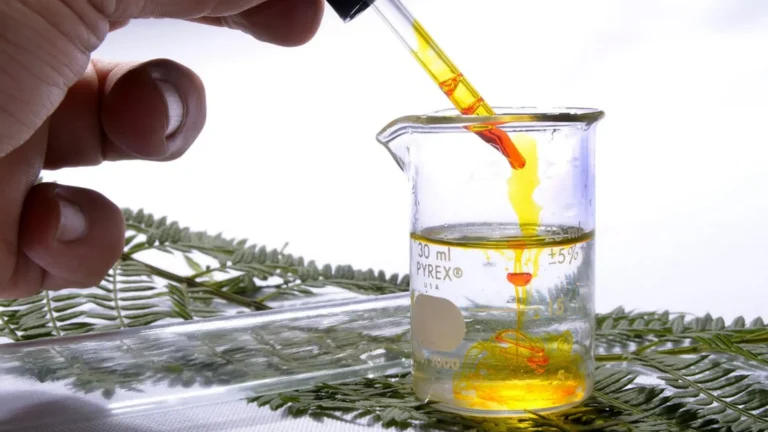
I’m a professional cosmetic formulator who’s obsessed with combining cannabis and cosmetics. Choosing cosmetic emulsifiers that work with cannabis matters when you’re making creams and lotions because infused oils and water need to stay evenly mixed. An ordinary water-free balm does not need an emulsifier, but a cream or lotion does. Skip it, and you’ll end up with a split mess and wasted ingredients.
Here’s my no-nonsense guide to five emulsifiers I use for cannabis skincare. We’ll look at what each one is good at, how it feels on the skin and what to watch out for.
Table of Contents
*As an Amazon Associate, I earn from qualifying purchases
Why Emulsifiers Matter in Cannabis Skincare
Emulsifiers have two ends. One is attracted to water and the other is attracted to oil. As you blend the two phases, the oil-loving end connects with the oil while the water-loving end connects with the water. The emulsifier gathers around the tiny droplets and helps stop them joining back together. That’s what keeps a cream or lotion properly mixed instead of separating in the pot.
How Cosmetic Emulsifiers Work
Emulsifiers are molecules with a water-loving side and an oil-loving side. Whisk them in, and they form tiny structures that trap oil and water together. That’s how you get a proper cream or lotion, instead of a pot of split liquid.
Choosing the Right Emulsifier for Cannabis Skincare
Choosing an emulsifier is not simply a matter of finding one labelled natural. Start with the product you want to make, then check whether the emulsifier suits the oil phase and the rest of the formula. Cannabis-infused oil is part of that oil phase, so count it alongside all your other oils, butters and oil-soluble ingredients.
Before choosing your emulsifier, think about:
- How much oil is in the formula and which oils you are using
- Whether you want a light lotion, a face cream or something richer
- Whether you are making an oil-in-water (O/W) or water-in-oil (W/O) emulsion
- The heating and mixing method the emulsifier needs
- Whether it works with your chosen pH, gums, preservatives and active ingredients
- Whether plant origin, vegan suitability or COSMOS approval matters to you
Types of Cosmetic Emulsifiers
Every emulsifier has a water-loving part and an oil-loving part, but the balance between the two varies. That balance helps determine whether it is better suited to an oil-in-water or water-in-oil emulsion.
In an oil-in-water emulsion, tiny droplets of oil are held throughout the water phase. These emulsions usually feel lighter and are commonly used for lotions and face creams. In a water-in-oil emulsion, droplets of water are held within the oil phase, producing richer and often more protective creams.
Natural vs Synthetic Emulsifiers
This is where it can become confusing. Plant-derived does not mean raw or unprocessed. Many natural-origin emulsifiers are made from plant ingredients using carefully controlled chemical processes. COSMOS Approved means that a raw material is permitted for use in COSMOS-certified formulations. It does not mean that every product made with it is automatically certified.
Vegan and natural do not mean the same thing either. Vegan tells you that the emulsifier does not contain animal-derived ingredients, while natural origin refers to where its raw materials came from and how it was made.
One mistake I see a lot is people thinking beeswax is an emulsifier. It isn’t. Beeswax thickens and gives structure to oils, but it cannot reliably hold oil and water together by itself. A water-containing cream made with beeswax alone is likely to separate, which can also interfere with its preservation.
Emulsification Challenges with Cannabis
Working with cannabis does not mean you need a special cannabis emulsifier. What matters is the form in which you add it. A cannabis-infused carrier oil is simply part of the oil phase and must be included when you calculate the total amount of oil in your formula. CBD isolate should be fully dissolved in a suitable oil before it is added.
Thick or resinous extracts and ready-made CBD ingredients can be more complicated because they may contain carriers, solvents or other ingredients of their own. These can affect the colour, smell, texture or stability of the finished product, so always check the supplier’s information. A change in colour or aroma does not necessarily mean that the emulsion is unstable.
If you need help planning the rest of your formula, my Skincare Formulation Essentials guide brings together the equipment, ingredients and preparation involved.
Top 5 Cosmetic Emulsifiers That Work With Cannabis
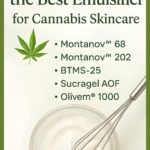
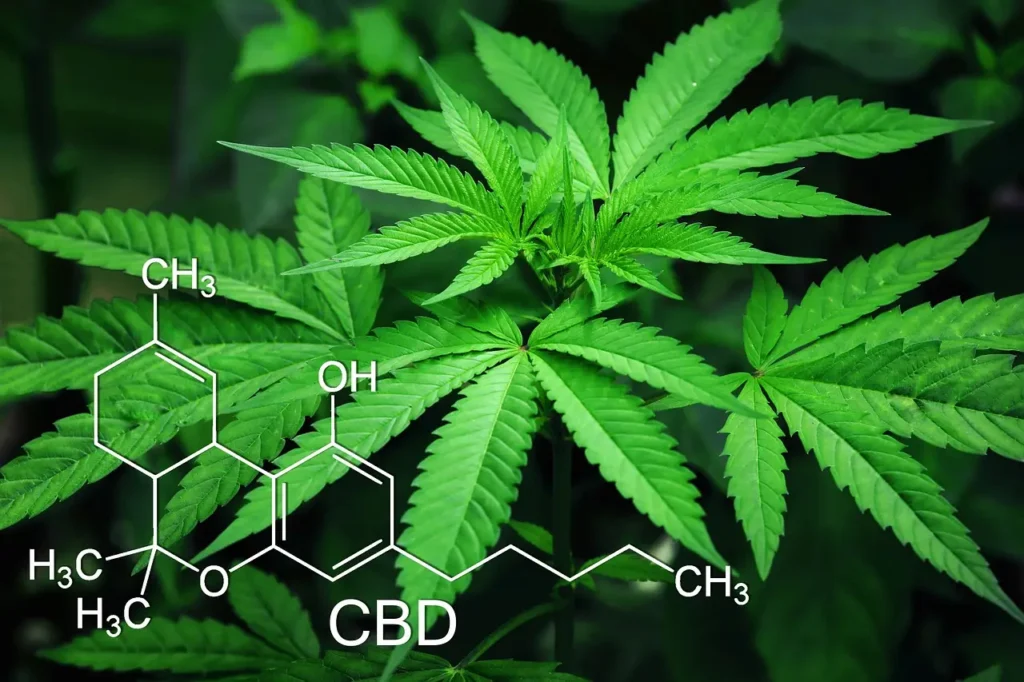
These are five emulsifiers I use and recommend, but they do not all make the same kind of product. Montanov™ 68, Montanov™ 202, BTMS-25 and Olivem® 1000 are mainly used for conventional oil-in-water creams and lotions. Sucragel AOF is different because it is particularly useful for making oil gels that turn milky when water is added.
Montanov™ 68
The INCI for Montanov™ 68 is Cetearyl Alcohol and Cetearyl Glucoside. It is a non-ionic, oil-in-water emulsifier made from renewable vegetable ingredients and is approved by COSMOS. It produces soft, rich creams without making them feel excessively heavy.
It is normally used at up to 5% and added to the oil phase. The oil and water phases are heated to around 75°C to 80°C before they are blended together. I find it dependable with cannabis-infused oils, provided the infused oil is included when calculating the complete oil phase. You can read more in my article about Montanov™ 68 Emulsifier.
Montanov™ 202
The INCI for Montanov™ 202 is Arachidyl Alcohol, Behenyl Alcohol and Arachidyl Glucoside. It is a non-ionic, oil-in-water emulsifier that produces lighter creams and lotions with a soft, matt finish. It is plant-derived, palm oil-free and approved by COSMOS.
It can be used at up to 5% and works across a broad pH range. It needs to be heated in the oil phase to around 80°C to 85°C, so you must consider how that temperature will affect any heat-sensitive oils or cannabis ingredients. I choose it when I want something lighter than the richer texture produced by Montanov™ 68.
BTMS-25
BTMS-25 has the INCI Behentrimonium Methosulfate and Cetearyl Alcohol. It is a cationic emulsifier, which means it also conditions the skin and hair. It gives creams and lotions a silky, powdery finish with plenty of slip, which is why it is particularly popular in haircare and body products.
BTMS-25 is added to the heated oil phase and can make a complete oil-in-water emulsion. Because it is cationic, it is not compatible with every ingredient, particularly anionic ingredients. Different suppliers give different recommended amounts, so check the directions for the grade you have bought. You can read more in my guide to Emulsifying Wax BTMS-25.
Sucragel AOF
Sucragel AOF contains Sweet Almond Oil, Glycerin, Water and Sucrose Laurate. It is a natural-origin, COSMOS-approved emulsifying system that turns vegetable oils into thick, transparent gels. When water is added during use, the gel changes into a light, milky emulsion that rinses away.
It is particularly useful for cleansing oils, makeup removers, massage gels and oil-to-milk products. Cannabis-infused oil can form part of the oil blend, although darker infused oils will naturally affect the colour and clarity. The oil must be added to the Sucragel very slowly while mixing or the gel will not form properly.
Olivem® 1000
The INCI for Olivem® 1000 is Cetearyl Olivate and Sorbitan Olivate. It is a plant-derived, oil-in-water emulsifier that forms liquid crystal structures and produces smooth creams with a comfortable skin feel. It is approved by COSMOS and works well in face and body products.
The manufacturer recommends 3 to 5% when it is used as the sole emulsifier, with a finished pH between 4.5 and 8. I find it a sensible choice for people learning to formulate because it is straightforward to use and produces a lovely cream when the formula is properly balanced.
If you want to see it in a complete formula, my cannabis body lotion recipe shows how I use Olivem® 1000 with cannabis-infused oil, water and a preservative.
Conclusion
These five cosmetic emulsifiers that work with cannabis each have their own strengths. Montanov™ 68 gives you richer creams, while Montanov™ 202 produces something lighter. BTMS-25 adds a silky, conditioning feel, Sucragel AOF is best for oil gels and Olivem® 1000 is a dependable choice for everyday creams and lotions.
There is no single best emulsifier for every formula. The right one depends on the texture you want, the size of your oil phase, the other ingredients and the way the product will be used. Get those things right and the emulsifier will quietly do its job, which is exactly what you want.
🎧 Listen Instead
 Spotify
 YouTube
FAQ
Can I use beeswax as an emulsifier?
Not on its own. Beeswax thickens and gives structure to oils, but it will not reliably keep an ordinary oil-and-water cream together without a proper emulsifying system. Traditional cold creams combine beeswax with borax, but that is a different system and not a straightforward substitute for a modern emulsifier.
What is the best emulsifier for beginners?
Olivem® 1000 is a good place to start because it can be used as the sole emulsifier and makes smooth oil-in-water creams. Montanov™ 68 is another dependable choice if you prefer a slightly richer cream. Whichever one you choose, follow the supplier’s recommended amount and processing method.
Do emulsifiers affect cannabis potency?
The emulsifier itself is not usually what reduces cannabinoid potency. Excessive or prolonged heat, exposure to light and air, and unsuitable storage can all affect cannabinoid stability. How you add the cannabis ingredient depends on its form, so follow its supplier’s instructions as well as the processing method for the emulsifier.
Are all cosmetic emulsifiers natural and vegan?
No. Natural origin, COSMOS approval and vegan suitability are separate claims. Montanov™ 68, Montanov™ 202, Sucragel AOF and Olivem® 1000 are plant-derived and approved by COSMOS. BTMS-25 is chemically manufactured, although some grades are made from vegetable raw materials and may be suitable for vegan formulations. Always check the information supplied with the exact product you are buying.
Why did my cannabis cream split after a few days?
A cannabis cream can split if the emulsifier does not suit the oil phase, the amount is wrong, the two phases were not heated or mixed properly, or another ingredient is incompatible with the emulsifying system. The finished pH can also affect stability. Cannabis-infused oil should be counted as part of the complete oil phase, just like every other oil in the formula.
What is the best emulsifier for cannabis cream?
There is no single best choice for every cannabis cream. Montanov™ 68 works well for richer creams, while Olivem® 1000 produces smooth, versatile face and body creams. Montanov™ 202 is better when you want a lighter texture, and BTMS-25 gives a more conditioning, silky finish. Whichever you choose, include the cannabis-infused oil when calculating the complete oil phase.

If you liked this blog post, I would love it if you shared it with a friend.
If you use Pinterest, please pin this post.