


Facial oil recipes for mature skin should reflect what your skin needs now. Perhaps it feels drier or more easily irritated than it used to, or you’ve noticed roughness and a crepey texture on your face, neck or décolletage. These four blends offer different ways to keep it soft, smooth and flexible, from light daytime care to richer evening conditioning.
Table of Contents
Choosing Facial Oil Recipes for Mature Skin
Getting older doesn’t mean we all need the same rich oil. Some of us want help with persistent dryness; others want a smoother face without much oily residue. Skin that has become easily irritated needs a different approach again.
These four blends give you a choice:
- Softness and Suppleness: for fine lines and crepey-feeling skin.
- Gentle Care: for skin that has become more easily upset.
- Smooth Daytime Care: for dullness and roughness, with a lighter finish.
- Rich Evening Care: for lasting dryness on the face, neck and décolletage.
Each recipe makes 100 g, with all quantities in grams. There are no added essential oils, and cannabis infusion is optional.
My Blend Your Own Facial Oil guide explains the individual oils and how to combine them. You’ll also find a free, one-page printable with all four recipes after the conclusion.
#1 Softness and Suppleness
If you’re noticing fine crinkles across your cheeks or neck, you may also find your skin feels less flexible. This blend helps retain moisture and keeps the surface soft, with a fine finish for those who don’t enjoy a heavy facial oil.
- Marula Oil softens the skin and gives smooth, easy spreading. It contains mainly Oleic Acid (Omega-9), alongside Palmitic and Stearic Acids. Together, these form part of an oil that conditions the skin and helps keep it supple.
- Rosehip Seed Oil supplies Linoleic Acid (Omega-6) and Alpha-Linolenic Acid (Omega-3). Linoleic Acid helps maintain the skin’s moisture-retaining barrier, which matters when mature skin starts losing moisture more easily. Rosehip also feels much drier than many richer oils, making it useful when you want conditioning with less fattiness.
- Rice Bran Oil helps reduce moisture loss and softens rough-feeling skin. It contains both Oleic and Linoleic Acids, plus naturally occurring tocopherols, tocotrienols and gamma-oryzanol, compounds with antioxidant activity. It also gives the blend smooth glide during application.
- Pomegranate Seed Oil brings a different fatty acid, Punicic Acid, often called Omega-5. It contributes to skin conditioning, and a small amount is enough to include it within this blend. Its unusual composition is interesting, but it doesn’t mean the oil can rebuild collagen or erase wrinkles.
The 40 g of Marula gives softness, while 30 g of Rosehip takes down the fatty feel. Rice Bran keeps the application smooth, and Pomegranate adds a small contribution without needing to make up much of the bottle. You should be able to spread a little easily over your face and neck without repeatedly rubbing the skin.
Recipe
For a 100 g batch, weigh:
- Marula Oil: 40 g
- Rosehip Seed Oil: 30 g
- Rice Bran Oil: 27.75 g
- Pomegranate Seed Oil: 2 g
- Rosemary Antioxidant: 0.25 g
Total: 100 g
Apply a small amount to clean, slightly damp skin. Spread gently over your face and neck, using light strokes rather than pulling at delicate areas. If your skin needs more moisture, use the oil after your usual moisturiser.
#2 Gentle Care
Your usual cleanser leaves your face tight, or the aftershave you’ve used for years has started to sting. Mature skin can become drier and more easily irritated, so this blend keeps things simple: three oils chosen to soften the skin and help it hold onto moisture.
- Apricot Kernel Oil is known for its mild, softening qualities and is a useful choice for dry or sensitive skin. It contains mainly Oleic Acid (Omega-9), alongside Linoleic Acid (Omega-6). The whole oil helps keep the skin smooth and flexible, with enough glide to spread it gently.
- Oat Oil helps reduce moisture loss and leaves dry, easily upset skin feeling softer. Its Oleic Acid (Omega-9), Linoleic Acid (Omega-6) and other naturally occurring lipids contribute to its conditioning properties. It also gives a velvety finish without stickiness.
- Evening Primrose Oil is often used to care for dry, sensitive skin. It supplies plenty of Linoleic Acid, which has a role in the skin’s moisture-retaining barrier, alongside Gamma-Linolenic Acid, usually called GLA. Both belong to the Omega-6 family. The oil adds fine, soft conditioning without making the blend heavier.
Apricot makes up just over half the recipe, giving softness and easy spreading. The 35 g of Oat adds velvet and helps retain moisture, while 10 g of Evening Primrose brings a finer feel. There’s enough glide to apply it without repeatedly rubbing skin that already feels tender.
Recipe
For a 100 g batch, weigh:
- Apricot Kernel Oil: 54.75 g
- Oat Oil: 35 g
- Evening Primrose Oil: 10 g
- Rosemary Antioxidant: 0.25 g
Total: 100 g
Apply a small amount to clean, slightly damp skin with gentle strokes. You can also use it after shaving, avoiding nicks or broken areas. Try it on a small area first, and stop if it stings or causes irritation.
#3 Smooth Daytime Care
If your face feels rough or looks dull, this blend offers softening care with a lighter finish. It suits a bare face, skin that needs conditioning after shaving, or anyone finding that make-up catches on dry patches.
- Tigernut Oil is known for its silky feel and its ability to soften the skin without leaving much oily residue. It contains mainly Oleic Acid (Omega-9), with some Linoleic Acid (Omega-6), and helps keep the skin smooth and flexible. Its fine texture makes it useful when you want daytime conditioning without a heavy coating.
- Moringa Oil softens dry, rough-feeling skin and helps it retain moisture. It is rich in Oleic Acid (Omega-9) and gives the skin a slight sheen, which is useful when your face looks dull. It also provides good glide, so a small amount spreads easily.
- Kiwi Seed Oil is known for its fine, dry feel and is used to condition dry, sensitive and mature skin. It contains a high proportion of Alpha-Linolenic Acid (Omega-3), alongside Linoleic Acid (Omega-6). The whole oil helps keep the skin soft and supple while lightening the feel of richer oils.
- Rosemary Antioxidant helps protect the oils against oxidation. Kiwi Seed Oil’s high polyunsaturated fatty acid content makes it particularly delicate, so I’ve used 0.5 g of Rosemary Antioxidant to give this blend extra protection from oxidation and rancidity.
Tigernut gives the silky softness, while Moringa adds glide and a little sheen. The 24.5 g of Kiwi Seed takes down the fattiness of the other two. The aim is smoother-feeling skin with enough conditioning to last through the day, without a heavy finish.
Recipe
For a 100 g batch, weigh:
- Tigernut Oil: 45 g
- Moringa Oil: 30 g
- Kiwi Seed Oil: 24.5 g
- Rosemary Antioxidant: 0.5 g
Total: 100 g
Spread a small amount over clean, slightly damp skin. After shaving, avoid any nicks or broken areas. If you wear make-up, let the oil settle before applying it. A little is enough to soften the surface without leaving your face oily.
#4 Rich Evening Care
If your skin feels dry again soon after applying skincare, this blend gives fuller, longer-lasting conditioning. It is for dry, crepey skin on the face, neck and décolletage, helping it retain moisture and feel smoother and more flexible.
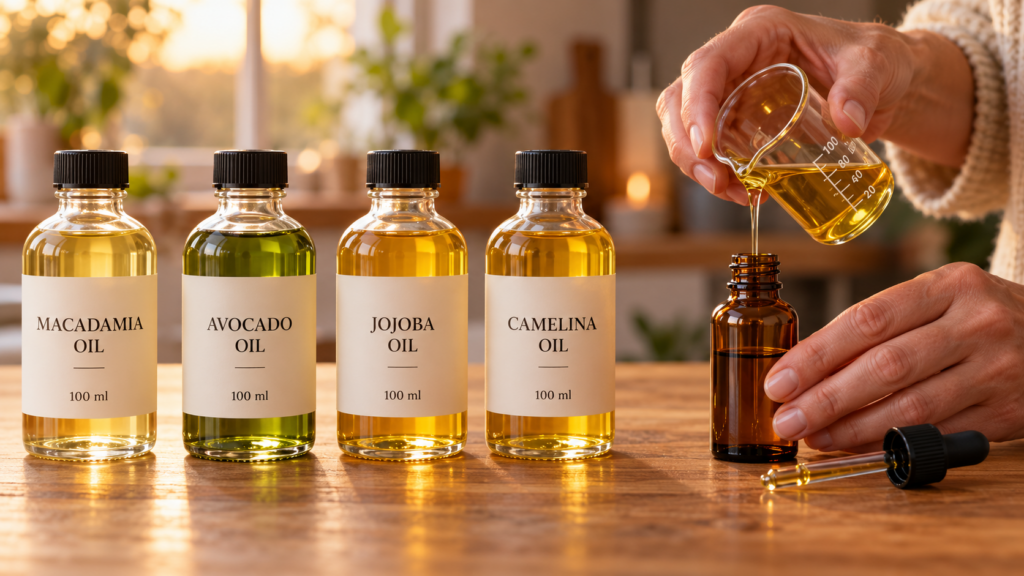
- Macadamia Oil is known for its rich softening qualities and is particularly useful for dry, rough-feeling skin. It contains Oleic Acid (Omega-9) and a notable amount of Palmitoleic Acid (Omega-7). The whole oil helps keep the skin supple, with a slower-settling finish that gives you time for a gentle massage.
- Avocado Oil softens dry skin and helps reduce moisture loss. It contains mainly Oleic Acid (Omega-9), alongside Palmitoleic Acid (Omega-7) and naturally occurring plant sterols. It adds fuller conditioning to areas that feel rough or less flexible.
- Jojoba Oil helps limit moisture loss, making it useful when your skin feels tight again later in the evening. It is a liquid wax rather than a triglyceride oil, so its composition differs from the other ingredients. It leaves a smooth, conditioned surface and has good resistance to oxidation.
- Camelina Oil helps soften the skin while bringing a much drier feel than Macadamia and Avocado. It supplies Alpha-Linolenic Acid (Omega-3) and Linoleic Acid (Omega-6). Linoleic Acid has a role in the skin’s moisture-retaining barrier, giving Camelina a useful contribution alongside its lighter texture.
The 40 g of Macadamia gives richness, with 15 g of Avocado adding extra softness. Jojoba helps reduce moisture loss, while the 20 g of Camelina takes down the fattiness. This is the fullest blend of the four, with enough glide to spread gently over your neck and décolletage.
Recipe
For a 100 g batch, weigh:
- Macadamia Oil: 40 g
- Avocado Oil: 15 g
- Jojoba Oil: 24.75 g
- Camelina Oil: 20 g
- Rosemary Antioxidant: 0.25 g
Total: 100 g
Apply a small amount to clean, slightly damp skin in the evening. Spread over your face, neck and décolletage with gentle strokes, without pulling or repeatedly rubbing delicate skin. Allow it to settle before dressing or going to bed.
Optional Cannabis Infusion
You can make all four facial oil recipes for mature skin with or without cannabis. If you’d like to include it, use these oils for the heat infusion:
- #1 Softness and Suppleness: Marula and Rice Bran together. You need 67.75 g of strained infused oil.
- #2 Gentle Care: Apricot Kernel and Oat together. You need 89.75 g of strained infused oil.
- #3 Smooth Daytime Care: Tigernut and Moringa together. You need 75 g of strained infused oil.
- #4 Rich Evening Care: Macadamia, Avocado, Jojoba and Camelina together. You need 99.75 g of strained infused oil.
Prepare a little extra because the cannabis holds onto some oil when strained. Follow the proportions in your chosen recipe, increasing each infusion oil proportionally.
After straining and cooling to room temperature, weigh out the required amount listed above. Then complete your blend:
- #1: add 30 g Rosehip Seed Oil, 2 g Pomegranate Seed Oil and 0.25 g Rosemary Antioxidant.
- #2: add 10 g Evening Primrose Oil and 0.25 g Rosemary Antioxidant.
- #3: add 24.5 g Kiwi Seed Oil and 0.5 g Rosemary Antioxidant.
- #4: add 0.25 g Rosemary Antioxidant.
Each finished blend totals 100 g. Keeping Rosehip, Evening Primrose and Kiwi Seed out of the heating step helps protect these delicate oils from unnecessary oxidation. Pomegranate can go in afterwards too.
My Cannabis-Infused Oils and Butters Guide explains how to prepare and make the infusion.
Making and Looking After Your Blend
You’ll need clean, completely dry utensils, a small glass beaker, suitable bottles and scales that can accurately weigh 0.25 g.
- Weigh the oils into your beaker, using the tare function between additions. If you’re using infused oils, weigh the strained, cooled portion first, then add the remaining oils.
- Add the Rosemary Antioxidant and stir thoroughly, including around the sides and bottom.
- Pour into clean, dry bottles and close immediately.
- Label with the blend name, ingredients and date. Clearly identify any cannabis-infused version.
There’s no need to heat the plain oils to mix them. If an ingredient has thickened in a cold room, let it return to room temperature before weighing.
Protecting the Oils
Blends #1, #2 and #4 contain 0.25 g Rosemary Antioxidant per 100 g. Blend #3 contains 0.5 g for additional protection of its delicate Kiwi Seed Oil.
These amounts refer to the particular extract used in these recipes. Check your supplier’s guidance if you use a different product. Rosemary Antioxidant is different from Rosemary Essential Oil; they aren’t interchangeable.
The antioxidant slows rancidity. It cannot restore spoiled oil or guarantee how long a blend will last.
Storage and Use
Keep your bottles tightly closed, somewhere cool and away from direct sunlight. Keep stock bottles of delicate oils, particularly Rosehip, Evening Primrose and Kiwi Seed, refrigerated according to their supplier’s instructions. Let a closed bottle come towards room temperature before opening it to help avoid condensation getting inside.
Make an amount you’ll use regularly. If you reduce a recipe, reduce every ingredient proportionally, including the antioxidant, and make sure your scales can weigh the smaller quantities accurately.
These water-free blends normally don’t need an antimicrobial preservative when water is kept out during making and use. Don’t add hydrosols, aloe juice or other watery ingredients, and avoid touching the dropper against your skin.
Discard oil that develops a stale, paint-like or crayon-like smell. Try a new blend on a small area first, avoid ingredients you know you’re allergic to, and stop if it causes irritation.
Conclusion
These facial oil recipes for mature skin give you four choices, depending on what you want from your skincare. Softness and Suppleness suits fine, crepey-feeling skin; Gentle Care keeps things simple for skin that has become easily upset. Smooth Daytime Care offers a lighter finish, while Rich Evening Care gives fuller conditioning for dry skin on the face, neck and décolletage.
Choose the one that sounds most useful to you. Apply a small amount and notice how your skin feels afterwards and later in the day. The right balance should leave it softer and more flexible, with a finish you enjoy.
My Blend Your Own Facial Oil guide explains the ingredients in more detail if you’d like to understand your oils or adjust a blend. Let the vegetable oils sing their own song.
Keep the Recipes
Download the free, one-page printable with all four facial oil recipes for mature skin, gram weights and shared making instructions. No email sign-up needed.
FAQ
What is the best facial oil for mature skin?
Choose according to how your skin feels and the finish you enjoy. Marula gives softening care with a fine finish, Oat adds velvety comfort, and Macadamia offers richer conditioning for persistent dryness. Blending oils lets you combine those benefits and adjust the fattiness.
Can facial oil help crepey skin?
Facial oil can soften dry, crepey-feeling skin and help it retain moisture, leaving the surface smoother and more flexible. This is useful on the face, neck and décolletage, where dryness can make fine crinkles more noticeable. Apply gently, without pulling at the skin.
Does facial oil reduce wrinkles?
Keeping the skin moisturised can soften the appearance of fine lines caused or exaggerated by dryness. Facial oils help by reducing moisture loss and smoothing the surface. Deeper wrinkles involve changes beneath the surface, so an oil blend won’t remove them.
Is facial oil good for menopausal skin?
Facial oil can be useful when skin becomes drier or less supple during menopause. Choose softening oils that help retain moisture, with a lighter or richer finish to suit you. If your skin has also become more sensitive, keep the blend straightforward and leave out added essential oils.
Can facial oil replace moisturiser on mature skin?
Facial oil provides softening lipids and helps reduce moisture loss, while a moisturiser also supplies water and ingredients that hold onto it. If your skin feels comfortable with oil alone, that may suit you. If it still feels tight, use a moisturiser and apply a little oil afterwards for extra conditioning.

If you liked this blog post, I would love it if you shared it with a friend.
If you use Pinterest, please pin this post.